

This guide explains verified scholarships in Africa, including government funding schemes, fully funded international scholarships, and postgraduate opportunities for African students.
Paying for university is difficult for many students across Africa. The good news is that there is no single route to funding. Depending on the country, students may qualify for government bursaries, national student-aid schemes, university-based scholarships, pan-African scholarships, or fully funded international scholarships in Africa.
Total scholarship funding across Africa has increased substantially in recent years. In practice, Africa’s funding landscape is a mix of scholarships, bursaries, and student-finance programmes, so students need to read each opportunity carefully before applying.
This guide focuses on verified programmes that are backed by official institutions. It does not assume that every opportunity is open all year. Application windows, eligible courses, and supporting-document requirements change, so students should always confirm the latest details on the official page before submitting anything.
Quick Glance: Scholarships in Africa
• Government schemes like NSFAS (South Africa) and HELB (Kenya) support local students.
• Pan-African programmes like Pan African University scholarships fund postgraduate study.
• International programmes like Chevening, DAAD, Erasmus Mundus, and Commonwealth offer fully funded opportunities.
• Some scholarships may waive IELTS if previous education was in English.
• Applications usually open 6–12 months before the academic year begins.
Table of Contents
What Counts As a Scholarship in Africa?
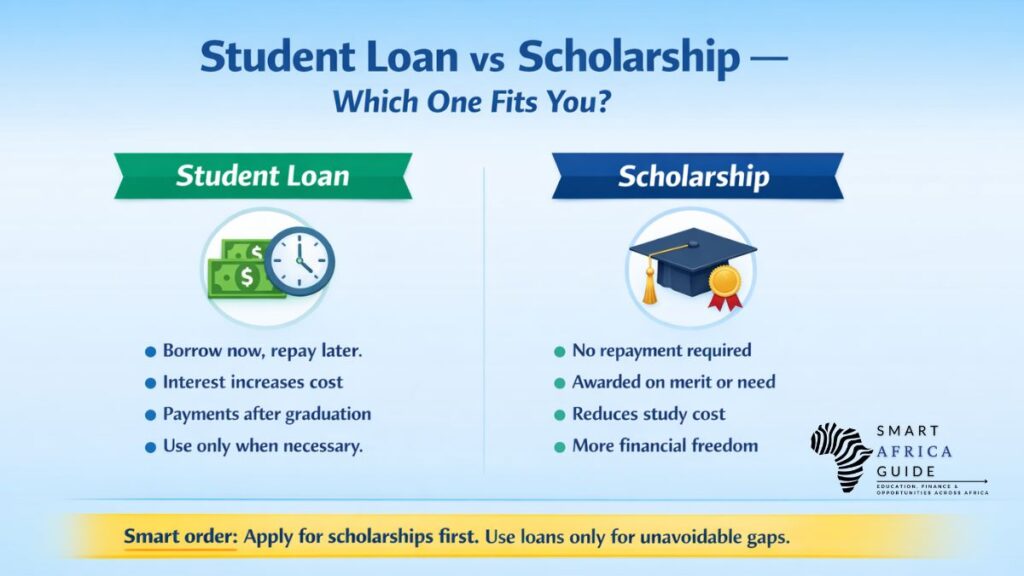
Students often use the word “scholarship” to describe any education funding, but official programmes are not all the same. Some are full bursaries that cover tuition and approved study costs. Some are loans with repayment terms. Others are fully funded postgraduate awards for study in Africa, Europe, or the UK. That difference matters because the eligibility rules, obligations, and benefits are not identical.
A good example is South Africa’s NSFAS scheme, which describes itself as a financial aid programme that provides fully subsidised funding for poor and working-class students studying at DHET-recognised institutions, while the bursary rules state that the annual amount covers the actual cost of tuition and other related costs prescribed in the national bursary rules.
By contrast, Nigeria’s NELFUND is presented as a student loan initiative, not a scholarship. In Kenya, HELB provides student-finance support and also points students to scholarship options and partner funds.
Government Scholarships in Africa

Government scholarships are one of the most reliable sources of education funding for students across Africa. These programmes are usually funded by national governments or international government partnerships and are designed to support students who meet academic and financial eligibility requirements.
One example is the National Student Financial Aid Scheme (NSFAS) in South Africa. NSFAS provides financial support to qualifying students studying at public universities and TVET colleges. Funding normally covers tuition and approved study-related costs for eligible students who meet the financial criteria.
Another verified option is the Pan African University Scholarship, which is supported by the African Union. This programme offers scholarships for master’s and doctoral programmes in selected African universities and focuses on areas such as science, technology, governance, and development.
In Nigeria, the Federal Ministry of Education Scholarship Awards provide funding opportunities for Nigerian students studying in universities and other higher institutions. These scholarships aim to support academic excellence and increase access to higher education.
Government scholarships often require students to meet specific criteria such as nationality requirements, academic performance, and enrollment in approved programmes. Students should always confirm details directly from official government or university sources before applying.
Major Scholarship Programmes Available to African Students
1) South Africa
For South African students, the most important verified funding route is usually NSFAS. NSFAS says its DHET bursary scheme provides fully subsidised funding for qualifying students registered at public universities and TVET colleges, and its bursary terms confirm that successful applicants may receive funding equal to actual tuition and other prescribed study-related costs.
NSFAS also publishes eligibility rules and conditions, so students should rely on those official documents instead of social media summaries.
South Africa also has additional bursary opportunities through employers and sector-linked programmes, but students should always verify these on the official organisation website before applying. When a bursary claims to cover tuition, accommodation, transport, books, or allowances, that should be checked against the official programme terms and not copied from third-party blog posts.
2) Kenya
In Kenya, one of the most recognised scholarship initiatives is the KCB Foundation Scholarship Programme, which supports academically talented students from financially disadvantaged backgrounds. The programme focuses primarily on secondary and tertiary education and is designed to help students who demonstrate strong academic potential but lack the financial resources to continue their studies.
The KCB Foundation scholarship programme provides support for tuition and other education-related costs for selected students. In addition to financial assistance, the programme often includes mentorship and leadership development opportunities that help students build skills beyond the classroom.
Kenyan students can also access other funding opportunities through national and institutional programmes. Government education platforms and university scholarship announcements regularly publish verified funding opportunities for students pursuing higher education.
Because education funding in Kenya comes from a mix of scholarships, bursaries, and financial-aid programmes, students should always verify the eligibility requirements and application details directly from the official programme website before applying.
3) Nigeria
In Nigeria, the Federal Ministry of Education publishes official scholarship and bursary announcements, including the Nigerian Scholarship Award and the Education Bursary Award, while the government’s Student Loan Initiative explains the structure of NELFUND as a tool to improve access to higher education.
Students should therefore distinguish between scholarship notices from the Ministry and loan support under NELFUND. They are both official, but they are not the same type of funding.
This distinction matters when students plan costs. A scholarship or bursary may not require repayment, but a student loan normally comes with formal conditions. The safest approach is to read the official call, confirm who is eligible, and check whether the programme is for undergraduate study, postgraduate study, or a specific category of students.
Pan-African Scholarships for African Students
4) Pan African University scholarships
The Pan-African University, an African Union initiative, is one of the strongest verified regional options for postgraduate students. Its official scholarships page says that successful applicants receive full scholarships covering tuition and living expenses, and its admissions information states that the African Union Commission offers full scholarships to successful candidates.
The university’s calls target master’s and PhD applicants in selected institutes and fields.
For students who want a scholarship within Africa, this is an important route because it is not just a general funding announcement. It is a formal, structured postgraduate system with specific institutes, admission requirements, and continent-wide eligibility criteria.
Fully Funded International Scholarships for African Students

5) Chevening Scholarships
Chevening is one of the best-known verified scholarships open to applicants from eligible countries, including many African countries. Chevening says its scholarship enables outstanding emerging leaders to pursue a one-year master’s degree in the UK, and its country pages confirm that the award is fully funded, including university tuition fees, a monthly stipend, travel costs, arrival and departure allowances, visa costs, and a travel grant for Chevening events.
Chevening’s eligibility page also states that applicants must be citizens of a Chevening-eligible country or territory, commit to returning home for at least two years after the award, and have at least 2,800 hours of work experience.
For African graduates who already have some work experience and want a taught master’s abroad, Chevening is a serious option. It is not an undergraduate scholarship, and the work-experience requirement means students should check eligibility before spending time on essays and references.
6) Erasmus Mundus Joint Masters
The Erasmus Mundus Joint Masters programme is another verified route for African students seeking funded postgraduate study. The European Commission’s Erasmus+ pages state that scholarships may cover participation costs, and contribute to travel, visa, and a living allowance.
The programme is open to students worldwide through selected joint master’s programmes, and the official guidance explains that applications usually go through the individual master’s consortium website rather than one single general application form.
This matters because many students search for “Erasmus scholarship” without realising that the process is course-specific. The official course page is the source that matters, not recycled deadline lists on random scholarship blogs.
7) DAAD scholarships for Sub-Saharan Africa and developing countries
The DAAD runs several official scholarship routes relevant to African students. Its In-Country/In-Region Scholarship Programme supports academics with a bachelor’s or master’s degree in regions including Sub-Saharan Africa, while its EPOS programme states that scholarships are available for graduates from developing and newly industrialised countries who have at least two years of professional experience.
DAAD is especially useful for students looking at development-related postgraduate study or regionally hosted programmes. Because DAAD has multiple scholarship streams, students should not rely on one article claiming “DAAD is open.” They should check the exact programme database entry and eligibility notes.
8) Commonwealth Scholarships
For students from eligible Commonwealth countries in Africa, Commonwealth Scholarships are another verified option. The Commonwealth Scholarship Commission states that Commonwealth Scholarships cover approved tuition fees, airfare to and from the UK, visa costs, and a living allowance for study based in the UK.
It also explains that different awards serve different purposes, including master’s, PhD, shared scholarships, and distance learning.
This is a good example of why students should always read the exact scholarship type. A Commonwealth Master’s award is not the same as a Shared Scholarship or a Distance Learning Scholarship, even though all sit under the same official umbrella.
9) Mastercard Foundation Scholars Program at partner universities
The Mastercard Foundation Scholars Program is delivered through partner universities rather than one single central student application page. One verified example is Ashesi University in Ghana.
Ashesi states that its Mastercard Foundation Scholars Program covers all fees and costs for room and board as well as learning resources, and includes additional socio-economic support to help students transition successfully into university and careers.
This is useful for students because it highlights a common mistake: searching only for “Mastercard scholarship application” instead of checking partner institutions directly. Many large scholarship programmes are administered through universities, not a single standalone application portal.
Scholarships Without IELTS for African Students

Many students believe that English language tests, such as IELTS, are always required for scholarships. However, several universities and scholarship programmes offer alternative ways to prove English proficiency.
In some cases, universities accept proof that the student previously studied in English. This is commonly called a “medium of instruction certificate,” which confirms that the student’s earlier education was conducted in English.
Certain international scholarships, including some Erasmus Mundus programmes, allow universities to determine language requirements individually. If a student has completed their previous degree in English, the IELTS requirement may be waived.
Similarly, some DAAD scholarships in Africa accept alternative proof of language proficiency depending on the host university and course requirements.
Students interested in scholarships without IELTS should carefully check the language requirements of each programme, because policies can vary between universities and specific scholarship calls.
Scholarships for Engineering Students in Africa
Engineering is one of the most supported fields in scholarship programmes because it contributes directly to national development, infrastructure, and technological innovation.
In South Africa, several industry-linked bursaries support engineering students. Many companies in sectors such as mining, energy, and manufacturing offer funding programmes designed to develop future engineers and technical professionals.
Across Africa, engineering students may also qualify for international opportunities such as DAAD engineering scholarships and Erasmus Mundus programmes that focus on fields like sustainable energy, environmental engineering, and information technology.
The Pan African University Institute for Basic Sciences, Technology and Innovation (PAUSTI) also offers scholarships for postgraduate engineering and science programmes. These initiatives aim to strengthen research and technical expertise across the continent.
Engineering scholarships in Africa often prioritize fields such as civil engineering, mechanical engineering, electrical engineering, and renewable energy technologies.
Scholarships for Master’s Students in Africa
Many scholarship opportunities available to African students are specifically designed for master’s degree programmes. These scholarships in Africa help students pursue advanced study in areas such as public policy, engineering, science, development studies, and business administration.
Several major programmes support master’s students from African countries. For example, Chevening Scholarshipsenable students to pursue a one-year master’s degree in the United Kingdom, while Erasmus Mundus Joint Master’s programmes allow students to study across multiple European universities.
Similarly, DAAD scholarships in Africa support postgraduate study in development-related fields, and Commonwealth Scholarships provide funding for master’s and doctoral programmes in the United Kingdom.
Within Africa itself, postgraduate opportunities are also available through institutions such as the Pan-African University, which offers scholarships for master’s and PhD programmes in specialised fields including science, technology, governance, and development.
Scholarships in Africa for master’s students usually require applicants to demonstrate strong academic performance, submit recommendation letters, and provide a clear motivation statement explaining their academic goals and future plans.

Frequently Asked Questions About Scholarships in Africa
What are the main types of scholarships in Africa?
Scholarships in Africa generally fall into several categories, including government-funded bursaries, university scholarships, corporate bursaries, and international scholarships. Government programmes such as NSFAS support local students, while international programmes such as Chevening and Erasmus Mundus allow African students to study abroad.
Are fully funded scholarships available for African students?
Yes, many fully funded scholarships are available for African students. Programmes such as Chevening, Erasmus Mundus, DAAD, and Commonwealth Scholarships provide funding that may include tuition fees, travel expenses, and living allowances.
Can African students get scholarships without IELTS?
In some cases, yes. Certain universities accept proof that a student previously studied in English instead of IELTS. This is commonly confirmed through a medium of instruction certificate. However, language requirements depend on the scholarship programme and university.
Which scholarships are best for master’s students from Africa?
Several programmes support master’s study for African students. Popular options include Chevening Scholarships, Erasmus Mundus Joint Master’s programmes, and DAAD scholarships for postgraduate studies in development-related fields.
How can students increase their chances of receiving a scholarship?
Students can improve their chances by maintaining strong academic performance, preparing well-written motivation statements, obtaining strong recommendation letters, and applying early. It is also important to carefully review eligibility criteria and submit all required documents.
What is the difference between a scholarship and a bursary?
A scholarship is usually awarded based on academic merit, leadership potential, or special achievements. A bursary is often awarded based on financial need and may sometimes include conditions such as working for the sponsoring organization after graduation.
Are there scholarships specifically for African students?
Yes. Several international scholarship programmes are designed specifically to support students from African countries. These include programmes funded by governments, universities, and international organizations.
Do scholarships cover all university expenses?
Some scholarships in Africa are fully funded and cover tuition fees, accommodation, travel costs, and living expenses. Others may only cover tuition or provide partial financial assistance.
When should students start applying for scholarships?
Students should begin searching and preparing scholarship applications at least six to twelve months before the academic year begins. Many programmes open applications well in advance of university admissions.
Where can students find verified scholarship information?
Students should rely on official scholarship websites, university announcements, and government education portals. This helps ensure that the information is accurate and reduces the risk of applying to fraudulent opportunities.
How students should choose the right scholarship path?
The best scholarship route depends on the student’s level and situation. For a South African undergraduate at a public university, a national bursary route such as NSFAS may be more realistic than an international scholarship. For a Kenyan student, HELB and partner funds may be the first place to start. For a working graduate aiming for a master’s degree abroad, Chevening, DAAD, Erasmus Mundus, or Commonwealth Scholarships may be more suitable. For Africa-based postgraduate study, Pan-African University is one of the clearest verified options.
How to avoid fake scholarship listings?
Students should only trust a scholarship when they can confirm it on an official institutional website. That usually means a government domain, a university domain, or the programme’s official site. Before applying, check four things: whether the scholarship is actually open, whether it is a scholarship or a loan, what costs it covers, and whether your course level and nationality are eligible. Official pages for NSFAS, HELB, NELFUND, Chevening, Commonwealth, DAAD, Erasmus Mundus, and Pan African University all provide this kind of detail.
Final Takeaway
There is no single “Africa scholarship portal” that replaces all others. The real system is broader: national student-aid schemes, verified bursaries, pan-African postgraduate scholarships, and fully funded international awards. Students who use official sources and match the opportunity to their level of study will avoid most of the confusion that comes from copied deadline lists and unverified scholarship blogs. The strongest starting points are the official pages for NSFAS, HELB, Nigeria’s education funding notices, Pan African University, Chevening, Erasmus Mundus, DAAD, Commonwealth Scholarships, and verified university partners such as Ashesi.

Varsha Asrani is a lecturer and education writer with experience as Visiting Faculty at AUPP and ATMC College, and as a Lecturer with TalentEdge and UpGrad. She is the Founder of the Asrani Institute of Education and Counselling. Varsha specializes in scholarships, e-learning, and career guidance for African students and professionals, and regularly visits Africa to gather first-hand insights that shape her research and articles.