


Last updated on July 2, 2026
NSFAS requirements are the rules students must meet before they can receive funding from the National Student Financial Aid Scheme. These rules look at your citizenship, household income, institution, course, academic progress, and supporting documents.
For the NSFAS bursary, applicants must generally be South African citizens or permanent residents, study at a public university or TVET college, and fall within the required income limit.
NSFAS states that the bursary is for students with a combined household income of not more than R350,000 per year. For students living with disabilities, the household income limit is R600,000 per year. SASSA grant recipients automatically qualify on financial eligibility.
Quick Glance
- You are a South African citizen or permanent resident.
- Your household income is R350,000 or less per year.
- Students with disabilities may qualify up to R600,000 household income.
- You study at a public university or TVET college.
- You meet the document, registration, and academic progression rules.
Table of Contents
Who Qualifies for NSFAS?

According to the official NSFAS eligibility criteria published by the National Student Financial Aid Scheme, funding is awarded based on income, academic progression, and registration at approved institutions. To be considered for funding, applicants must meet the core NSFAS eligibility rules. These requirements ensure that funding goes to students from low-income households who meet the academic and citizenship criteria expected by NSFAS.
- South African citizen with a valid ID
- Applying or accepted at a public university or TVET college
- Household income must not exceed the NSFAS threshold
- SASSA beneficiaries automatically qualify for consideration
- Matric certificate or latest academic results
- Applicants with disabilities must register and submit the required disability documentation
- Returning students must meet academic progression rules from their institution
- Applicants must not have already completed a previous higher-education qualification funded by NSFAS
Income Rules You Must Meet
The income rule is one of the most important NSFAS requirements. For the bursary, the income limits are:
| Student Type | Household Income Limit |
| General applicant | R350,000 or less per year |
| Student living with a disability | R600,000 or less per year |
| SASSA grant recipient | Automatically qualifies financially |
NSFAS checks financial eligibility using information from government and third-party sources. The NSFAS consent form allows NSFAS to verify income and employment details for the applicant, parent, guardian, or spouse.
This means your application can be delayed or rejected if your declared income does not match the information NSFAS receives during verification. Providing accurate income documents helps prevent verification delays and gets you to the stage of Funding Eligible.
Does Being a SASSA Beneficiary Help?
Yes. SASSA grant recipients automatically qualify on financial eligibility for NSFAS bursary funding.
However, this does not mean the full application is automatically approved. You must still meet the other NSFAS requirements. For example, you must still study at a public institution, register for an approved qualification, and submit any documents requested on your myNSFAS profile.
NSFAS Requirements
NSFAS has specific requirements for different categories of students. It is important that you understand them clearly before applying.
Academic Requirements for NSFAS
NSFAS does not only check income. It also checks whether you meet academic and registration rules.
First-time applicants must meet the admission requirements of the university or TVET college where they want to study. NSFAS does not replace the institution’s admission decision. You must first be accepted or registered for a funded qualification.
Returning students must meet academic progression rules. If you failed too many modules, exceeded the allowed funding period, or did not progress according to your institution’s rules, NSFAS may stop or reject funding.
This is why some students qualify financially but still fail the NSFAS academic check. Students who fail progression may need supporting documents to appeal later.
NSFAS Requirements for Returning Students
The NSFAS requirements for returning students are slightly different. You must:
- Pass enough modules according to your institution rules
- Follow the n+ rule NSFAS requirements (limited funding years)
- Stay registered in an approved qualification
If you do not meet academic progression, your funding may stop even if you qualified before.
NSFAS Requirements for TVET Colleges
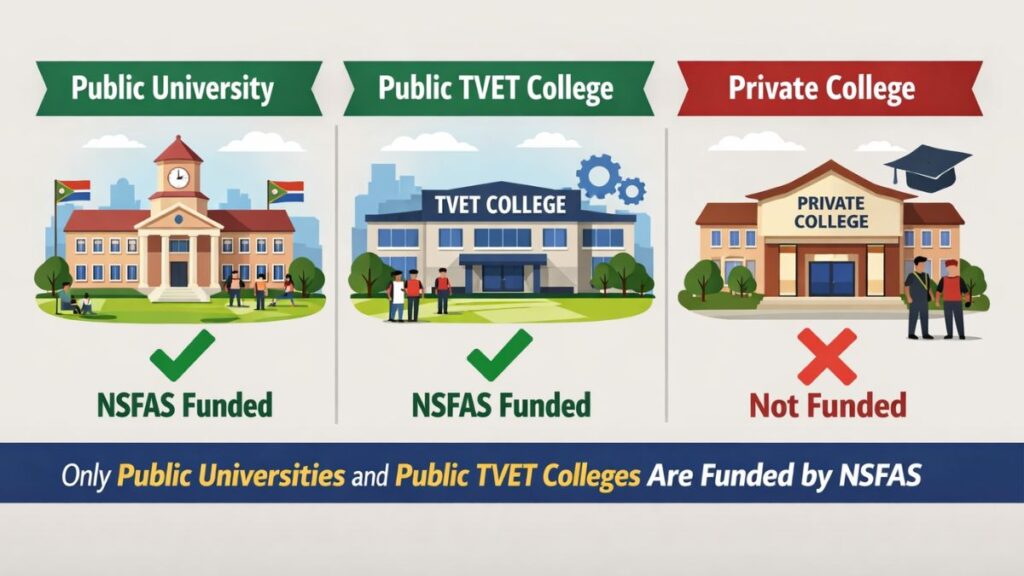
NSFAS funds students at public TVET colleges if they meet the financial and registration requirements. NSFAS states that TVET applicants must fall within the maximum income threshold of up to R350,000 combined gross family income per year and must be admitted or have a firm offer for enrolment at a college.
TVET students should check:
- The college must be a public TVET college.
- The programme must be funded by NSFAS.
- The student must meet the college’s progression rules.
- Registration details must be submitted correctly to NSFAS.
- Attendance and academic performance may affect continued funding.
If you are at a private college, NSFAS bursary funding will usually not apply.
NSFAS Requirements if Your Parents Cannot Be Verified
If your parent or guardian cannot be verified, you must follow the unverified parent NSFAS requirements. This usually includes:
- Submitting an affidavit explaining the situation
- Providing alternative proof of income or unemployment
- Uploading supporting documents
Failure to resolve this can delay your application.
NSFAS Requirements for Undergraduate Students
The NSFAS requirements for undergraduate students apply to first-time university students. You must:
- Meet university admission requirements
- Come from a qualifying household income
- Register for an approved course
Undergraduate funding is the most common type of NSFAS support.
NSFAS Requirements for Students with Disabilities

Students living with disabilities have a higher household income threshold of R600,000 per year for bursary funding consideration.
They may also need to submit:
- NSFAS Disability Annexure A.
- Medical or psychological report.
- Assessment from a registered healthcare professional.
- Disability support office confirmation where applicable.
- Any extra documents requested by the institution or NSFAS.
These documents must be submitted during the application phase, not after.
NSFAS Documents Required for Applications
| Document | Who Must Submit | Important Notes |
| Certified copy of South African ID | All applicants | Must be a valid green barcoded ID or smart ID card |
| ID copies of parents, guardian or spouse (Death certificate or sworn affidavit if a parent is deceased) | Dependent applicants | Required for household income verification |
| Proof of household income | If household earns income | Latest payslips, IRP5, UIF letter, or affidavit if unemployed |
| SASSA grant confirmation | SASSA beneficiaries | Confirms automatic financial eligibility |
| Disability Annexure or medical confirmation | Applicants with disabilities | Required to qualify under R600,000 income threshold |
| Consent form (signed) | All applicants | Allows NSFAS to verify income with third parties |
| Proof of registration | Returning students | Institution submits academic registration data to NSFAS |
Final Thoughts
Understanding NSFAS requirements properly can save you from unnecessary funding delays or rejection. The rules are clear, but many students miss small details that affect their application. If you meet the income limits, study at an approved institution, and submit the correct documents, you have a strong chance of approval. Before applying, take a few minutes to review the NSFAS requirements again and make sure everything is in place.
FAQs
What are the main NSFAS requirements for 2026/27?
The main NSFAS requirements are South African citizenship or permanent residence, household income within the allowed limit, registration at a public university or TVET college, an NSFAS-funded qualification, and correct supporting documents.
What is the NSFAS income limit?
For the NSFAS bursary, the household income limit is R350,000 or less per year. For students living with disabilities, the limit is R600,000 or less per year. SASSA grant recipients automatically qualify on financial eligibility.
Do SASSA beneficiaries need proof of income for NSFAS?
SASSA beneficiaries automatically qualify financially, but they must still complete the application correctly and submit any documents requested on the myNSFAS portal.
Does NSFAS fund private colleges?
No. NSFAS generally funds public universities and public TVET colleges. Students at private colleges usually need to look for private bursaries, employer funding, or other scholarship options.
Can international students apply for NSFAS?
NSFAS funding is generally reserved for South African citizens and permanent residents studying at public institutions. International students do not normally qualify for NSFAS funding.
Is there a specific age criteria for NSFAS?
There is no strict NSFAS requirements age limit, but funding is generally intended for students who have not already completed a qualification. Older students can still apply if they meet all other NSFAS requirements.
Can permanent residents apply for NSFAS?
Yes. NSFAS states that applicants must be South African citizens or permanent residents for 2026 applications.
Permanent residents must still meet the income, institution, qualification, and document requirements.
Can you apply if your parents are unemployed or deceased?
Yes, you can still apply if your parents or guardians are unemployed or parents deceased. NSFAS may ask for additional documents in such cases.

Varsha Asrani is a lecturer and education writer with experience as Visiting Faculty at AUPP and ATMC College, and as a Lecturer with TalentEdge and UpGrad. She is the Founder of the Asrani Institute of Education and Counselling. Varsha specializes in scholarships, e-learning, and career guidance for African students and professionals, and regularly visits Africa to gather first-hand insights that shape her research and articles.

