


A Master’s degree in South Africa is classified as NQF Level 9, while a PhD (Doctorate) is classified as NQF Level 10, the highest level on the National Qualifications Framework. That distinction reflects differences in research depth, academic independence, and knowledge contribution.
Students, employers, and even graduates often ask this question because the terminology can feel technical. The National Qualifications Framework (NQF) was designed to standardise how learning achievements are recognised across the country, yet many people only encounter the system when applying for postgraduate study or evaluating credentials.
Understanding where a Master’s and a PhD sit on the framework is more than an academic exercise. These levels influence admissions, career pathways, professional recognition, and international comparisons. Once the structure is clear, most of the common confusion disappears.
Quick Glance
- Master’s Degree = NQF Level 9 in South Africa
- PhD / Doctorate = NQF Level 10, the highest academic level
- Level classification reflects research depth and academic independence, not study duration
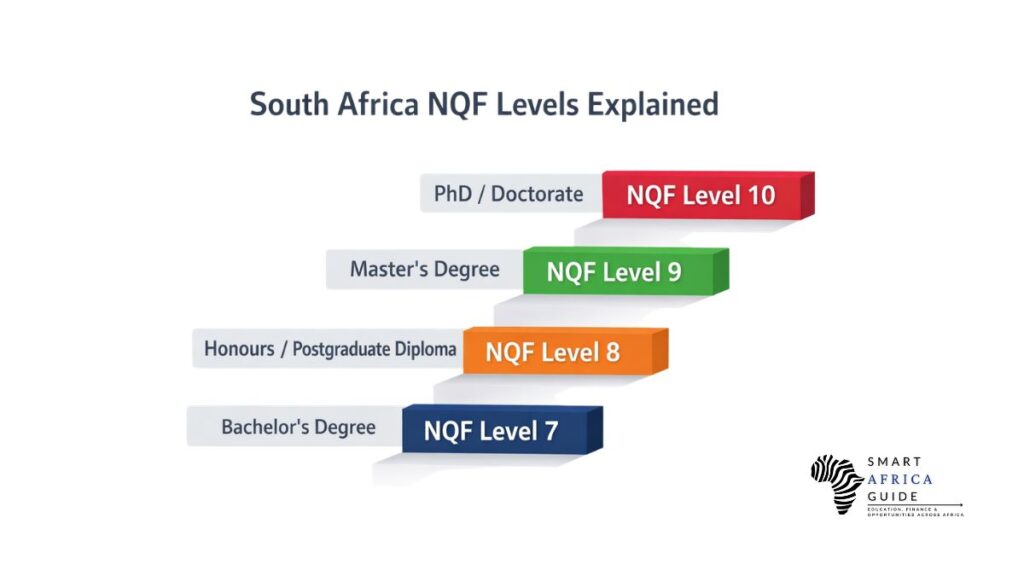
- NQF Level 7 = Bachelor’s Degree, Level 8 = Honours / Postgraduate Diploma
- Levels are standardised and verified by the South African Qualifications Authority (SAQA)
Table of Contents
The Purpose of the NQF System

South Africa’s National Qualifications Framework provides a single, organised structure that categorises all recognised qualifications. Instead of viewing education purely by years of study, the NQF evaluates learning based on complexity, knowledge depth, and expected competencies.
The framework spans ten levels, starting from foundational education and moving through certificates, diplomas, degrees, and finally doctoral research. Each level represents a shift in intellectual demand rather than just time spent studying.
This system ensures that qualifications awarded by universities, colleges, and training institutions follow consistent national standards. Without such a framework, comparing academic achievements across institutions would become highly subjective.
Where a Master’s Degree Fits: NQF Level 9
A recognised Master’s qualification is placed at NQF Level 9. This position signals advanced academic development beyond undergraduate and honours-level study.
At Level 9, learners are expected to demonstrate:
- Highly specialised knowledge within a discipline
- Advanced analytical and evaluative skills
- Research competence and methodological understanding
- Independent academic judgement
Unlike earlier qualifications that may rely heavily on coursework and examinations, Master’s degrees usually involve a significant research component. This may take the form of a dissertation, thesis, or structured research project.
The defining characteristic of Level 9 study is intellectual independence. Students must engage critically with existing theories, identify gaps or problems, and present reasoned conclusions supported by evidence.
Why Level 9 Represents a Major Academic Shift
Many students underestimate the difference between honours-level study (Level 8) and Master’s-level study (Level 9). The transition is not merely about studying more advanced material.
At honours level, students deepen specialisation and begin engaging with research concepts. At the master’s level, research becomes central rather than supplementary.
This means learners must:
- Frame research questions
- Evaluate academic literature rigorously
- Apply appropriate methodologies
- Defend interpretations logically
The expectation is no longer passive learning. Knowledge must be interrogated, challenged, and applied in original ways.
PhD and Doctoral Study: NQF Level 10
A PhD, also referred to as a Doctorate, occupies NQF Level 10, the highest qualification level within the South African system.
Level 10 is fundamentally distinct from all preceding stages. Doctoral research is defined by originality and contribution rather than mastery alone.
Doctoral candidates must produce work that:
- Contributes new knowledge to a field
- Demonstrates deep theoretical expertise
- Reflects advanced research capability
- Withstands expert academic examination
Coursework, if present, plays a minimal role. The qualification is awarded based on the quality, rigour, and originality of the research output.
What Makes Level 10 Academically Unique
The leap from Level 9 to Level 10 is often misunderstood. A Master’s degree demonstrates advanced research competence. A PhD demands the creation of new knowledge.
Doctoral study requires:
- Identification of unresolved scholarly problems
- Development of original theoretical or empirical insights
- Sustained independent inquiry
- Scholarly defence before specialists
This is why PhD research typically spans several years. The process is not about completing modules but about producing a defensible intellectual contribution.
Comparing NQF Level 9 and Level 10
Although both qualifications belong to postgraduate education, their academic functions differ considerably.
Master’s Degree (Level 9)
- Validates advanced expertise
- Develops research proficiency
- Builds analytical depth
- Prepares for doctoral study
PhD / Doctorate (Level 10)
- Establishes scholarly authority
- Requires original contribution
- Represents peak academic qualification
- Advances disciplinary knowledge
These distinctions affect academic careers, research roles, and professional recognition.
Common Misconceptions Students Encounter
“Is a Master’s Degree NQF Level 8?”
No. Level 8 includes honours degrees and postgraduate diplomas. Master’s qualifications are placed at Level 9 due to their research and analytical demands.
“What Level Is a PhD Compared to Degrees?”
A PhD sits at Level 10, above all other academic qualifications within the framework.
“Is Level 10 Just Another Postgraduate Step?”
Not exactly. Level 10 is qualitatively different because it centres on knowledge creation rather than advanced learning alone.
“Can Professional Experience Replace These Levels?”
Work experience may influence admissions or recognition of prior learning, yet qualification levels remain formally defined by national standards.
Why NQF Levels Matter for Academic Progression
NQF classifications influence how students move through the education system. Universities design entry requirements with these levels in mind.
A typical progression follows:
- Bachelor’s Degree → Level 7
- Honours / Postgraduate Diploma → Level 8
- Master’s Degree → Level 9
- PhD / Doctorate → Level 10
Each transition requires evidence of readiness for higher cognitive and research demands.
Employer and Industry Relevance
Employers frequently reference NQF levels when evaluating qualifications. The classification provides a shorthand indicator of knowledge complexity and academic development.
For instance:
- Research-intensive roles may require Level 9 or Level 10
- Academic positions often specify doctoral qualifications
- Professional bodies may align competencies with NQF levels
These distinctions affect hiring, promotion, and salary benchmarking.
International Recognition and Comparisons
Students often attempt to equate South African NQF levels with foreign systems. While broad parallels exist, precise equivalence varies.
Generally:
- NQF Level 9 aligns with Master’s-level qualifications internationally
- NQF Level 10 aligns with Doctoral-level qualifications internationally
Recognition still depends on institutional, regulatory, and professional evaluation frameworks.
The Role of SAQA in Qualification Classification
The South African Qualifications Authority (SAQA) maintains the integrity of the framework. It verifies qualifications, ensures consistency, and supports comparability.
SAQA’s responsibilities include:
- Registering recognised qualifications
- Maintaining level descriptors
- Supporting international equivalence discussions
- Preventing misrepresentation of credentials
When uncertainty arises regarding qualification status or level, SAQA serves as the authoritative reference point.
Academic Depth vs Duration: An Important Distinction

One persistent misunderstanding involves equating qualification level with study duration. The NQF does not classify credentials purely by years spent studying.
Instead, levels reflect:
- Intellectual complexity
- Depth of theoretical engagement
- Research intensity
- Learner autonomy
This explains why doctoral research represents Level 10 regardless of variations in completion time.
FAQs
What NQF level is a PhD in South Africa?
A PhD in South Africa is classified as NQF Level 10, the highest level on the framework. It represents advanced doctoral research focused on producing original knowledge.
What NQF level is a master’s degree in South Africa?
A Master’s degree is placed at NQF Level 9. This level reflects advanced postgraduate study with a strong research component.
Is a PhD level 7 or 8?
No, a PhD is neither Level 7 nor Level 8. It is classified as NQF Level 10.
Is NQF level 7 equivalent to a degree?
Yes, NQF Level 7 typically corresponds to a Bachelor’s degree. It represents undergraduate-level higher education.
Is level 10 a PhD?
Yes, NQF Level 10 includes PhD and other doctoral qualifications. It is the highest academic level in South Africa.
Final Clarification
The classification of postgraduate qualifications within South Africa’s framework is precise and consistent:
Master’s Degree → NQF Level 9
PhD / Doctorate → NQF Level 10
Recognising this structure helps students plan academic routes, interpret admission criteria, and understand the hierarchy of qualifications without confusion.

Varsha Asrani is a lecturer and education writer with experience as Visiting Faculty at AUPP and ATMC College, and as a Lecturer with TalentEdge and UpGrad. She is the Founder of the Asrani Institute of Education and Counselling. Varsha specializes in scholarships, e-learning, and career guidance for African students and professionals, and regularly visits Africa to gather first-hand insights that shape her research and articles.