

Last updated on July 6, 2026
If you’ve ever looked at a job advert asking for “NQF Level 6” or a course prospectus listing “NQF Level 7” and had no idea what that actually meant, you’re not the only one. Nobody sits you down and explains NQF Levels properly — it just shows up on forms and adverts as if everyone already knows.
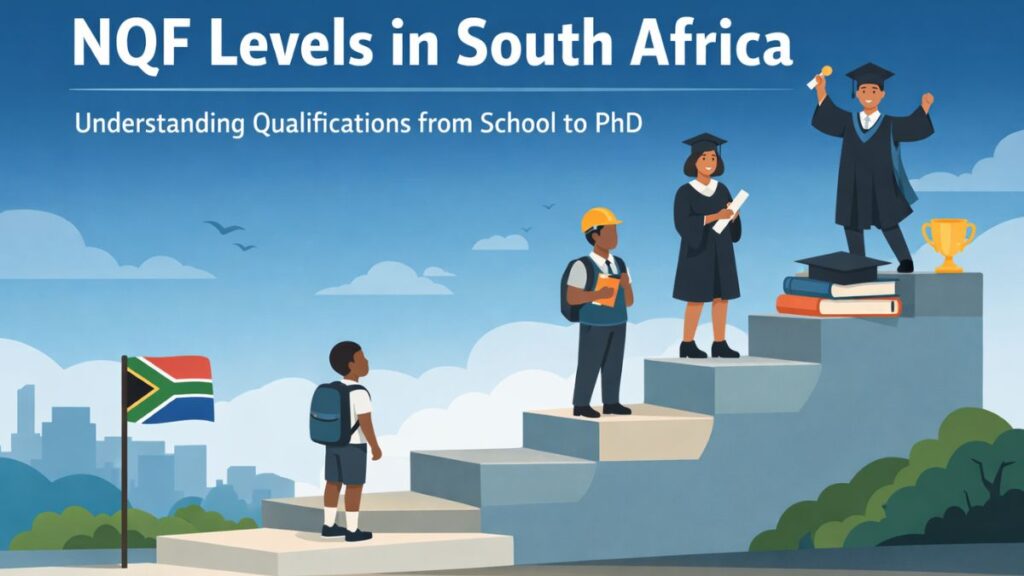
Here’s the short version: the NQF (National Qualifications Framework) is how South Africa ranks every qualification, from Grade 9 all the way to a PhD, on a scale of 1 to 10. It’s managed by SAQA, the South African Qualifications Authority. The number tells you two things — how advanced the qualification is, and what you’re allowed to study or apply for next.
Quick Glance
- Matric counts as NQF Level 4, no matter which pass category you got
- A Diploma (Level 6) is not the same as a Bachelor’s degree (Level 7)
- MBChB is NQF Level 8, not 7, because of its 6-year length
- You need to complete one NQF level before moving to the next
- The credit count (not just the level number) tells you how long a qualification takes
Table of Contents
What Is NQF?
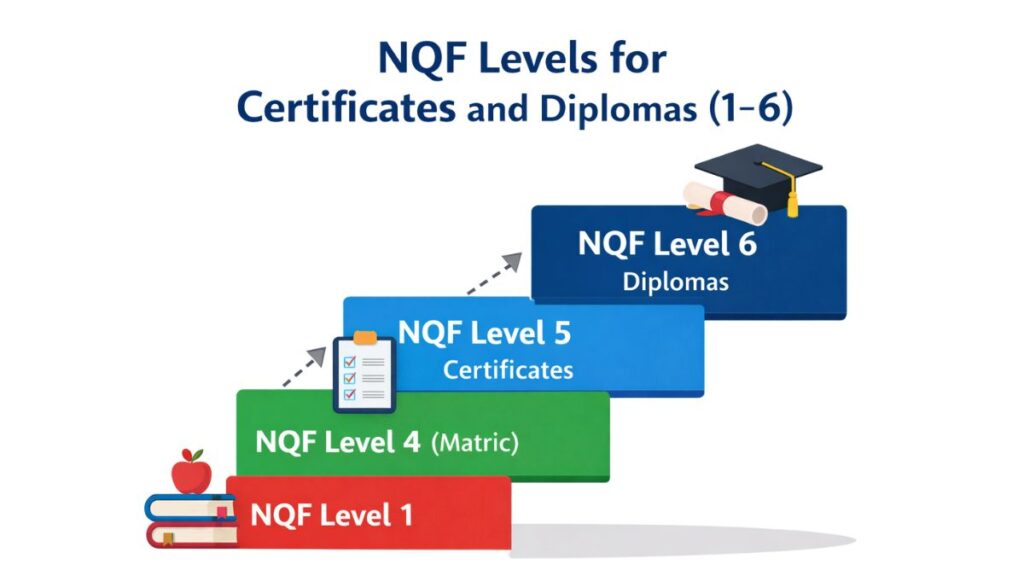
NQF stands for National Qualifications Framework. It’s South Africa’s official system for classifying every qualification — school, TVET, university, and workplace — on one standardised scale of 1 to 10, so that a school, a college, and a university are all speaking the same language when they talk about a “level.”
It’s managed by SAQA (the South African Qualifications Authority), which registers qualifications and checks that they meet national standards. In practice, the NQF exists to do three things:
- Let you compare qualifications from different institutions on equal terms
- Tell you what you’re eligible to study next
- Give employers a consistent way to read a candidate’s education level
NQF Levels Table
| NQF Level | Qualification Type | Example | Typical Credits |
| 1 | General Education | Grade 9 | — |
| 2 | General/Vocational | Grade 10 | — |
| 3 | General/Vocational | Grade 11 | — |
| 4 | School Completion | Matric (NSC) | 120–130 |
| 5 | Higher Certificate | Higher Certificate | 120 |
| 6 | Diploma | National Diploma | 240–360 |
| 7 | Bachelor’s Degree | BA, BCom, BSc | 360 |
| 8 | Honours / PG Diploma | Honours Degree | 120 |
| 9 | Master’s | MA, MSc, MBA | 180 |
| 10 | Doctorate | PhD | 360 |
Three bodies oversee different parts of the framework: Umalusi handles schooling (Levels 1–4), the Council on Higher Education (CHE) handles university qualifications (Levels 5–10), and the QCTO handles workplace and occupational qualifications (Levels 1–8).
What Each Level Actually Means

NQF Level 4 — Matric
This is the one most people are searching for. NQF Level 4 covers a completed Matric (National Senior Certificate), and it doesn’t matter which pass category you got — Bachelor’s Pass, Diploma Pass, Higher Certificate Pass, or NSC without endorsement — all of them sit at Level 4. The pass category affects what you can apply for next, not your NQF level itself. Vocational equivalents like the NC(V) Level 4 also count.
With NQF Level 4, you can apply for a Higher Certificate (Level 5), a Diploma (Level 6), or — if your Matric pass and subjects meet the requirements — a Bachelor’s degree (Level 7) directly.
→ For pass requirements and APS scores, see Matric in South Africa.
NQF Level 5 — Higher Certificate
One step above Matric. A Higher Certificate is usually a one-year, 120-credit programme that either gets you straight into entry-level work or bridges you into a Diploma or Degree if your Matric results weren’t strong enough to go there directly.
NQF Level 6 — Diploma
National Diplomas and Advanced Certificates sit here — typically 2–3 year, career-focused qualifications with 240–360 credits. This is not the same as a degree. A Diploma qualifies you for skilled, practical roles and can also be used to bridge into a degree programme later.
→ Full breakdown: NQF Levels for Certificates and Diplomas
NQF Level 7 — Bachelor’s Degree
A standard Bachelor’s degree — BA, BCom, BSc, and so on — is 360 credits at NQF Level 7. Advanced Diplomas also sit at Level 7, which is where a lot of the confusion between “diploma” and “degree” comes from. They’re the same level, but a Bachelor’s is academic and an Advanced Diploma is usually more career/practical in focus.
→ Full breakdown: NQF Level 7 Explained and Degrees in South Africa
NQF Level 8 — Honours / Postgraduate Diploma
Completed after a Bachelor’s, an Honours degree or Postgraduate Diploma is usually 120 credits and is the standard entry requirement for a Master’s. One exception worth knowing: the MBChB (Bachelor of Medicine and Bachelor of Surgery) is registered at NQF Level 8 even though it’s a first degree — because of its six-year length and much larger credit load (1,200+ credits) compared to a standard bachelor’s.
NQF Level 9 & 10 — Master’s and Doctorate
A Master’s degree (MA, MSc, MBA) is NQF Level 9. A PhD is NQF Level 10 — the top of the framework, awarded for original research.
→ Full breakdown: Master’s and PhD in South Africa
Final Thought
Once you know your NQF Levels, everything else on a course prospectus or job advert starts making sense — it tells you exactly where you stand and what’s realistically next, whether that’s a Higher Certificate, a Diploma, or a straight run at a Bachelor’s degree. If you’re still in the Matric-to-university stage of that journey, funding is usually the next question, and that’s where NSFAS comes in.
FAQs
What NQF level is a diploma?
A National Diploma is Level 6. An Advanced Diploma is Level 7.
Is a Bachelor’s degree NQF Level 7?
Yes. All standard Bachelor’s degrees are Level 7.
What NQF level is Matric equivalent to?
Level 4, regardless of which pass category you achieved.
What NQF level is MBChB?
MBChB is Level 8. Despite being a first professional degree, due to its extended duration and credit load.
Can I skip an NQF level?
No. You generally need to complete a lower level (or its recognised equivalent) before progressing — you can’t jump from Level 4 straight to Level 7, for example, unless your Matric pass specifically qualifies you for direct degree entry.

Varsha Asrani is a lecturer and education writer with experience as Visiting Faculty at AUPP and ATMC College, and as a Lecturer with TalentEdge and UpGrad. She is the Founder of the Asrani Institute of Education and Counselling. Varsha specializes in scholarships, e-learning, and career guidance for African students and professionals, and regularly visits Africa to gather first-hand insights that shape her research and articles.