

Last updated on May 26, 2026
Yes, NSFAS can fund an Advanced Diploma, but only in specific situations. Funding is not based on the course alone. It depends on how the Advanced Diploma fits into your academic journey, your previous qualification, and whether you are still within the NSFAS funding limits.
This is exactly where most students go wrong. Two students can apply for the same Advanced Diploma, and one gets approved while the other gets rejected. The difference is not the course. It is their academic path.
Quick Glance
- NSFAS can fund an Advanced Diploma, but only if it fits into your academic progression
- Funding is more likely when moving from a Diploma to an Advanced Diploma in the same field
- It must be a full time course at a public university or TVET college
- Funding may be rejected if it is treated as a second qualification or you exceeded funding limits
- NQF Level 7 status does not guarantee funding; progression matters more than level
Table of Contents
How NSFAS Looks at an Advanced Diploma

An Advanced Diploma is not treated like a basic undergraduate qualification.
It sits at NQF Level 7, which is the same level as a degree. However, it is usually taken after completing a Diploma or Degree and is meant to deepen knowledge in a specific field.
Because of this, NSFAS does not automatically assume you are continuing your studies. Instead, it checks whether this qualification is a clear academic progression or a new qualification altogether.
That single distinction determines whether funding is possible.
When NSFAS Is Likely to Fund an Advanced Diploma
Funding becomes possible when the Advanced Diploma clearly continues your previous studies.
For example, a student moving from a Diploma in Engineering into an Advanced Diploma in Engineering is following a logical academic path. In such cases, NSFAS may approve funding because the student is progressing within the same field.
Another important factor is that the course must be studied full-time at a public university or TVET college. NSFAS does not fund private institutions or part-time study, regardless of the qualification.
Students must also still meet the basic requirements, including income eligibility and academic performance. But even if those are met, progression is what carries the most weight.
If your NSFAS status looks approved but payments are not moving, your file may still be under review. Read this guide on NSFAS funding under investigation to understand what it means.
Where Most Applications Get Rejected
The most common reason for rejection is that the Advanced Diploma is treated as a second qualification.
If a student has already completed a qualification with NSFAS funding and then applies for an Advanced Diploma in a different or unrelated field, NSFAS is likely to decline the application. The system is designed to fund one structured academic path, not multiple unrelated ones.
Another major factor is the funding limit, often referred to as the N+ rule. NSFAS only funds a student for a limited number of years based on the duration of their qualification. Once that limit is reached, further study is usually not covered.
This means even a valid Advanced Diploma can be rejected if the student has already used up their funded years.
In some cases, students may be asked to sign an NSFAS Acknowledgement of Debt (AOD) if their funding status changes or if part of their studies is no longer fully covered. This usually happens when a qualification falls outside standard funding rules, such as when it is treated as a second qualification.
Why the NQF Level Creates Confusion
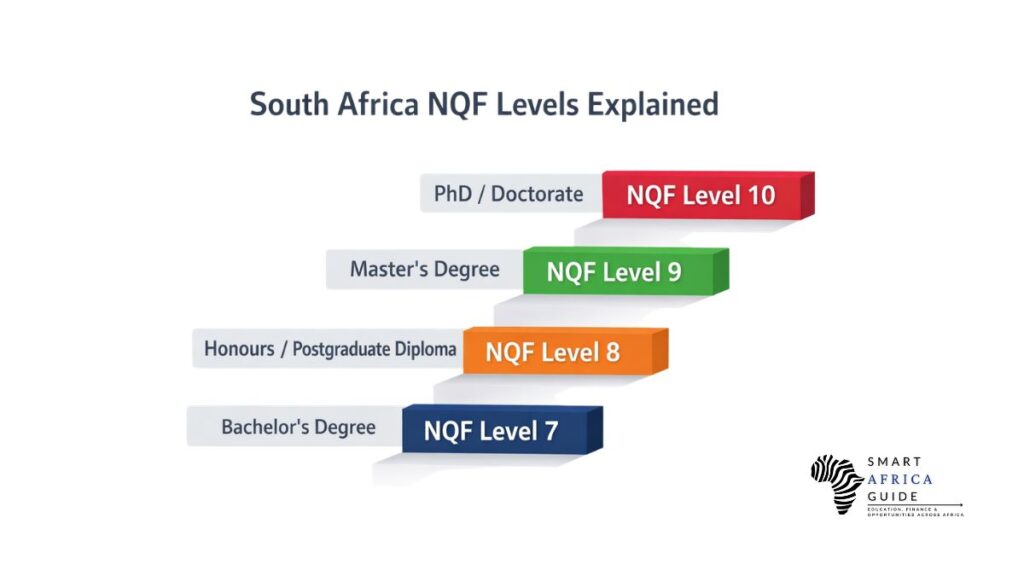
Many students assume that because an Advanced Diploma is at NQF Level 7, it is automatically considered progression.
That is not always true.
NSFAS does not look at the level in isolation. It looks at where you are coming from. Moving from NQF Level 6 to Level 7 in the same field supports progression. Moving sideways or restarting at the same level does not.
This is why understanding your academic pathway matters more than understanding the qualification itself.
Is an Advanced Diploma Postgraduate or Undergraduate?
An Advanced Diploma sits between undergraduate and postgraduate study.
It is not a full postgraduate qualification like a master’s degree, but it is also not a basic undergraduate qualification. It is typically taken after a Diploma or Degree and is often used to specialise or prepare for further study.
This “in-between” position is one of the reasons NSFAS evaluates it case by case instead of applying a fixed rule.
Who Qualifies for an Advanced Diploma
Admission into an Advanced Diploma usually requires a relevant Diploma or Degree in a related field.
Each institution sets its own requirements, but most expect:
- A qualification in the same or similar field
- A minimum academic average
- Completion of required subjects
From a funding perspective, qualifying for admission does not guarantee NSFAS funding. The academic path and funding history still play a bigger role.
What Comes After an Advanced Diploma
An Advanced Diploma is often used as a bridge to higher qualifications.
Depending on the institution, students may progress to:
- A postgraduate diploma
- An honours degree
- Further specialised study
This is one of the reasons NSFAS may fund it when it forms part of a longer academic pathway.
What NSFAS Actually Evaluates Before Approving

Before funding an Advanced Diploma, NSFAS looks at:
- Your previous qualification
- Whether the new course is a continuation or a restart
- How many funded years you have already used
- Whether the course is offered at a public institution
- Whether you meet income and academic requirements
The decision is not based on a single factor. It is based on how all of these come together.
Does NSFAS fund an Advanced Diploma after a Diploma?
Yes, NSFAS may fund an Advanced Diploma after a Diploma if it is in the same or a closely related field. This is considered academic progression, which increases the chances of approval.
Is an Advanced Diploma considered a second qualification by NSFAS?
It can be treated as a second qualification if it does not clearly continue your previous studies. In such cases, NSFAS is likely to decline funding.
What NQF level is an Advanced Diploma?
An Advanced Diploma is at NQF Level 7, which is the same level as a bachelor’s degree.
Can NSFAS fund you after completing a qualification?
In most cases, NSFAS does not fund a second qualification. However, if the new qualification is a direct continuation and you are still within funding limits, it may still be considered.
Final Answer
NSFAS does fund Advanced Diplomas, but only when the qualification fits into a clear academic progression, and the student is still within the allowed funding period. The decision is not about whether the course is valid, but whether it continues what you have already started. If the Advanced Diploma builds directly on your previous studies and you have not exceeded your funded years, approval is possible. If it looks like a second qualification or a new direction, funding is unlikely.

Varsha Asrani is a lecturer and education writer with experience as Visiting Faculty at AUPP and ATMC College, and as a Lecturer with TalentEdge and UpGrad. She is the Founder of the Asrani Institute of Education and Counselling. Varsha specializes in scholarships, e-learning, and career guidance for African students and professionals, and regularly visits Africa to gather first-hand insights that shape her research and articles.

