

If you are stuck on the question “What NQF level is a degree in South Africa?” you are not alone. Many students see “NQF Level” on application forms, NSFAS information, and job posts, then wonder whether a BA, BCom, or BSc all sit at the same level.
Here is the accurate answer, based on South Africa’s official higher education framework:
A Bachelor’s Degree in South Africa is usually pegged at NQF Level 7 (most common), but in some cases it can be pegged at NQF Level 8 depending on the degree structure and total credits.
Let us unpack that in plain language so it actually makes sense.
Quick Glance
• A Bachelor’s Degree in South Africa most commonly exits at NQF Level 7
• Some Bachelor’s Degrees exit at NQF Level 8 if structured as 480-credit degrees
• BA, BCom, and BSc are all Bachelor’s Degree designators under the same framework rules
• NQF level reflects learning complexity and qualification design, not marks obtained
• A Diploma exits at NQF Level 6, while an Advanced Diploma exits at Level 7
Table of Contents
First, What Does “Degree NQF Level” Mean?
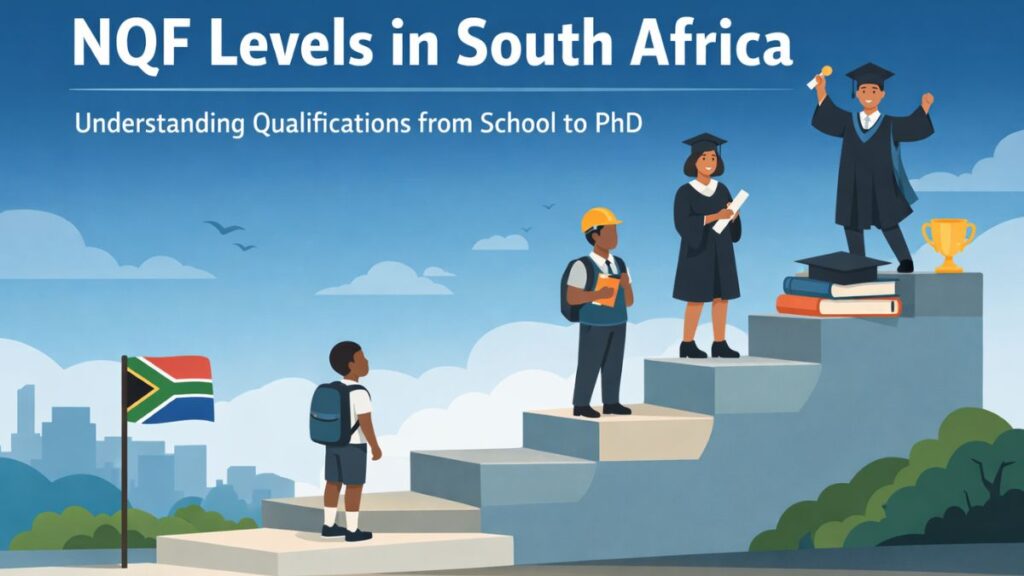
South Africa uses a nationally regulated framework for higher education qualifications. In this framework, each qualification type (Higher Certificate, Diploma, Bachelor’s Degree, Honours, and so on) has a defined NQF exit level and credit requirements.
So when someone asks for your bachelor’s degree NQF level, they are asking:
“At what recognised exit level does this qualification sit in the national system?”
Degree NQF Level in South Africa
What NQF level is a degree?
Officially, the framework recognises a Bachelor’s Degree in two common structures:
- Bachelor’s Degree (360 credits)
NQF Exit Level: 7
- Bachelor’s Degree (480 credits)
NQF Exit Level: 8
In other words, the most typical bachelor’s degree you see (often three years, 360 credits) is Level 7. Some bachelor’s degrees are designed with a higher volume of learning and can exit at Level 8.
That is the reason people get confused. They assume “a degree is always Level 7” or “a degree is always Level 8.” The truth is: it depends on the structure and exit level.
Which NQF level is BA?
A BA (Bachelor of Arts) is a Bachelor’s Degree designator listed under the national framework. Bachelor’s Degrees can exit at NQF Level 7 (360 credits) or NQF Level 8 (480 credits), depending on the programme.
So if someone asks which NQF level is BA, the practical answer is:
- Most BA degrees are Level 7
- Some BA degrees (where structured as 480 credits) can be Level 8
What NQF is a BCom?
A BCom (Bachelor of Commerce) is also listed as a Bachelor’s Degree designator in the framework.
So the answer is the same:
- A typical BCom (360 credits) exits at NQF Level 7
- A BCom structured at 480 credits can exit at NQF Level 8
This is why, when you are unsure, the safest approach is to check your university’s qualification page or your official academic record, because it usually states the NQF level clearly.
What About a BSc?
A BSc (Bachelor of Science) is also a Bachelor’s Degree designator.
So again:
- Most BSc degrees are NQF Level 7
- Some can be NQF Level 8 if designed as a 480-credit bachelor’s degree
Bachelor’s Degree NQF Level vs Honours
This is where many people mix things up.
A Bachelor’s Honours Degree is not the same thing as a Bachelor’s degree. It is a separate qualification type that sits at:
- NQF Level 8
- Minimum credits: 120 at Level 8
So if a friend says, “My degree is Level 8,” it might mean one of two things:
- They have an Honours degree (Level 8), or
- Their Bachelor’s degree is the 480-credit version that exits at Level 8
That is why checking the qualification name matters.
What NQF Level is a Diploma?

This question comes up a lot because students want to compare diplomas to degrees.
Under the national framework:
A Diploma exits at:
- NQF Exit Level: 6
- Usually 240 credits, with a longer option shown as 360 credits (still Level 6)
An Advanced Diploma exits at:
- NQF Exit Level: 7
- Minimum credits: 120 at Level 7
So, in simple comparison terms:
- Diploma = Level 6
- Advanced Diploma = Level 7
- Bachelor’s Degree = usually Level 7 (sometimes Level 8)
- Honours = Level 8
Why This Matters for NSFAS and Admissions
Universities, bursaries, and funding programmes often use NQF levels to set entry rules. For example, postgraduate study usually requires an appropriate bachelor’s degree, and Honours is positioned as a postgraduate specialisation qualification at Level 8.
So if a form asks for your “highest NQF level,” it is not trying to confuse you. It is trying to place your qualification correctly in the national system.
FAQs
What NQF level is a degree in South Africa?
Most bachelor’s degrees exit at NQF Level 7 (360 credits). Some bachelor’s degrees can exit at NQF Level 8 (480 credits) depending on how the qualification is structured.
Degree NQF level: Is BA the same level as BCom and BSc?
Yes. BA, BCom, and BSc are all Bachelor’s Degree designators. They typically exit at Level 7, but can be Level 8 if designed as a 480-credit bachelor’s degree.
What NQF is a BCom?
A BCom is a Bachelor’s Degree. Most exit at NQF Level 7, while some programmes can be structured to exit at Level 8.
What NQF level is a diploma?
A Diploma exits at NQF Level 6. If it is an Advanced Diploma, that exits at NQF Level 7.
Conclusion
Understanding the degree in South Africa (NQF level) becomes much easier once the framework rules are clear. In South Africa’s higher education system, a bachelor’s degree is most commonly positioned at NQF Level 7, while certain degree structures may exit at Level 8 depending on credit design and qualification type. The key point is that the NQF level reflects academic complexity and learning outcomes, not prestige or difficulty.
Once you recognise how degrees are positioned in the NQF system, application requirements and eligibility criteria start to make far more sense.

Varsha Asrani is a lecturer and education writer with experience as Visiting Faculty at AUPP and ATMC College, and as a Lecturer with TalentEdge and UpGrad. She is the Founder of the Asrani Institute of Education and Counselling. Varsha specializes in scholarships, e-learning, and career guidance for African students and professionals, and regularly visits Africa to gather first-hand insights that shape her research and articles.