


Last updated on September 29, 2026
The main difference between NATED and NCV is their purpose, entry point and final qualification. NCV is a three-year vocational programme that normally starts after Grade 9 and progresses from NQF Level 2 to Level 4. NATED, also called Report 191, consists of N-level certificates. N4, N5 and N6 are registered at NQF Level 5; after completing the required workplace experience, a student may qualify for the National N Diploma at NQF Level 6.
This distinction is important because an N6 certificate is not the same qualification as a National N Diploma. This updated guide compares NATED and NCV using information from SAQA, DHET and QCTO.
Table of Contents
Quick Answer: Difference Between NATED and NCV
- NCV: Levels 2, 3 and 4; usually entered after Grade 9; three years of full-time vocational study.
- NATED: N-level courses, commonly N4–N6 for post-school business, services and engineering studies.
- N4–N6 certificates: NQF Level 5.
- National N Diploma: NQF Level 6 after N4, N5 and N6 plus the prescribed workplace experience.
- Important: SAQA records 30 June 2026 as the last date for enrolment for the registered National N Diploma and 30 June 2029 as the last date for achievement. Students should confirm current programme availability directly with a public TVET college.
Difference Between NATED and NCV
Knowing the difference between NATED and NCV is especially important because the two programmes have different entry requirements, study structures, qualification levels and pathways to employment or further education.
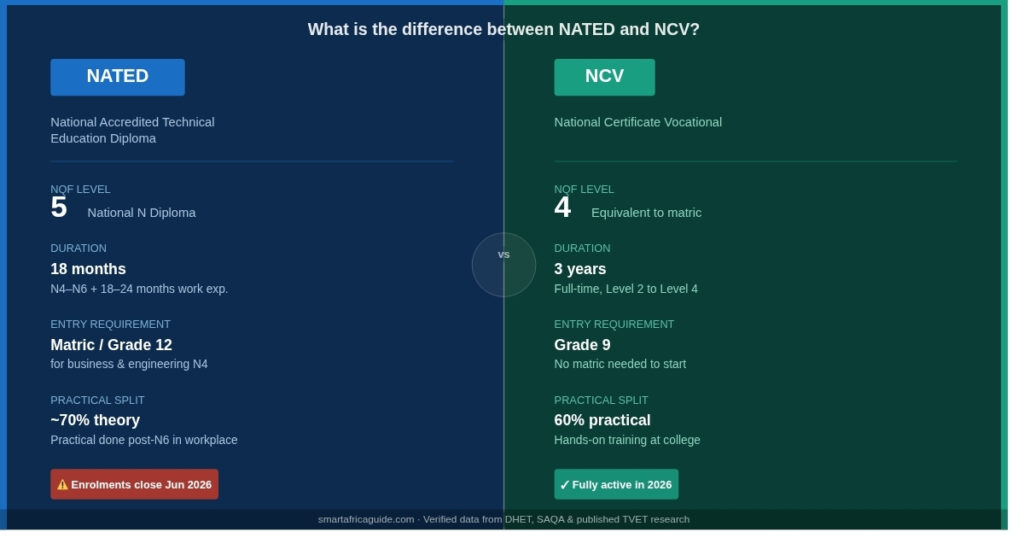
| Factor | NATED / Report 191 | NCV |
|---|---|---|
| Full name | National Accredited Technical Education Diploma programmes | National Certificate (Vocational) |
| Common names | Report 191, N-courses, N-levels | NC(V) or NCV |
| Structure | N-level certificates; N4, N5 and N6 form part of the route to the National N Diploma | Levels 2, 3 and 4 |
| Typical entry point | Depends on the programme. N4 programmes commonly require an appropriate Grade 12 or equivalent qualification. | Grade 9 or an equivalent qualification for entry to Level 2, subject to college requirements |
| Study schedule | Engineering courses commonly use trimesters; business and services courses commonly use semesters | Normally a full-time academic-year programme |
| Final level | N4–N6 certificates are at NQF Level 5. The completed National N Diploma is at NQF Level 6. | NCV Level 4 is at NQF Level 4 |
| Workplace experience | Required before the National N Diploma can be awarded—normally 18 months for business/services or 24 months for engineering, depending on the programme | No separate post-study workplace period is required to receive the NCV Level 4 certificate |
| University access | Possible, but admission is not automatic and depends on the institution and programme | NCV Level 4 can provide access to higher education when the statutory and institution-specific subject requirements are met |
| Current position | The SAQA registration record lists 30 June 2026 as the last enrolment date and 30 June 2029 as the last achievement date for the National N Diploma qualification | NCV remains an active vocational pathway |
What Is NATED?

NATED programmes are also known as Report 191 programmes or N-courses. They have historically included engineering, business and services fields offered through TVET colleges. You can read our separate explanation of what NATED means.
A learner does not receive the National N Diploma merely by passing N6. SAQA explains that N4, N5 and N6 must be followed by or integrated with the relevant practical workplace learning. The required period is generally 18 months for business and services programmes or 24 months for engineering programmes.
The resulting National N Diploma is registered at NQF Level 6. By comparison, the individual National N certificates at N4, N5 and N6 are registered at NQF Level 5. See the official SAQA National N Diploma record.
What Is NCV?
NCV means National Certificate (Vocational). It is a vocational learning route offered at public TVET colleges across Levels 2, 3 and 4. Students generally enter NCV Level 2 after Grade 9 and study for three academic years to complete NCV Level 4.
NCV Level 4 is registered at NQF Level 4, the same framework level as the National Senior Certificate. Being on the same NQF level does not make the two qualifications identical: they have different purposes, curricula and exit outcomes.
Is NATED Higher Than NCV?
The completed National N Diploma is registered at a higher NQF level than NCV Level 4: the diploma is at Level 6 while NCV finishes at Level 4. However, N6 by itself is not an NQF Level 6 diploma. The N4–N6 certificates are Level 5, and the prescribed workplace experience must also be completed before the National N Diploma can be awarded.
An NQF level indicates the complexity of learning; it does not automatically mean that one qualification is “better” for every career. A student should consider entry requirements, the occupational field, college accreditation and the requirements of prospective employers or universities.
NATED and NCV Duration
How Long Does NCV Take?
NCV normally takes three full-time academic years: one year each for Levels 2, 3 and 4. A student may take longer if subjects need to be repeated.
How Long Does NATED Take?
The classroom portion depends on the programme. Business and services students commonly complete N4, N5 and N6 over approximately 18 months, while engineering courses may follow trimester schedules. The National N Diploma additionally requires the relevant workplace experience. Therefore, it is misleading to describe the complete diploma route as only 18 months.
Can NATED or NCV Lead to University?
Both routes may lead to further study, but neither guarantees admission. NCV Level 4 applicants must satisfy the applicable higher-education admission rules and the subject requirements of the chosen institution. A National N Diploma holder may also apply for related higher-education programmes, but each university decides whether the qualification and subjects meet its admission criteria.
SAQA states that the National N Diploma can articulate vertically to a related bachelor’s degree at NQF Level 7 and horizontally to a related diploma or advanced certificate at Level 6. Articulation means that a pathway may exist; it is not an automatic offer of admission. See SAQA’s qualification FAQ.
Does NSFAS Fund NATED and NCV?
NSFAS may fund eligible students studying approved programmes at public TVET colleges, subject to the funding rules for the relevant academic year. Funding is not automatic merely because a course is called NATED or NCV. The student, college and programme must meet the applicable requirements.
Read our detailed guide explaining whether NSFAS funds NATED courses, and always confirm current eligibility through the official NSFAS website.
Is NATED Being Phased Out?
The SAQA record for the National N Diploma shows that the qualification passed its registration end date. It lists 30 June 2026 as the last date for enrolment and 30 June 2029 as the last date for achievement. Because the enrolment date has passed, prospective students should not rely on old advertisements or assume that a college can still register a new learner on the programme.
Students already enrolled should confirm their remaining subjects, workplace-experience requirements and completion timeline with their college. Prospective students should ask the college about the relevant occupational qualification registered under the Quality Council for Trades and Occupations. Use the QCTO website to check current occupational qualifications and accredited providers.
Which One Should You Choose?
Understanding the difference between NATED and NCV helps students choose the qualification that best matches their education level, career plans and preferred style of learning.
- You completed Grade 9 and want vocational secondary-level study: NCV Level 2 may be the appropriate entry route, subject to the college’s requirements.
- You are already enrolled in N4–N6: Ask your college how to complete outstanding certificates and workplace experience before the final achievement date.
- You want to begin a new post-school vocational qualification: Ask the college about current QCTO occupational qualifications and verify the programme before paying.
- You plan to attend university: Check the exact admission and subject requirements of your intended institution before choosing either route.
- You require NSFAS funding: Confirm that the institution is a public TVET college, the programme is eligible and you meet the current NSFAS rules.
Frequently Asked Questions
Is N6 Equivalent to a Diploma?
No. N6 is a National N Certificate at NQF Level 5. The National N Diploma is awarded only after the required N4, N5 and N6 certificates and the prescribed workplace experience have been completed.
What NQF Level Is a National N Diploma?
The National N Diploma is registered at NQF Level 6. The individual N4, N5 and N6 certificates are at NQF Level 5.
Is NCV Level 4 the Same as Matric?
NCV Level 4 and the National Senior Certificate are both registered at NQF Level 4, but they are not identical qualifications. They have different purposes, subjects and exit outcomes.
Can NCV Level 4 Take Me to University?
It can provide access to higher education if you meet the statutory subject requirements and the additional admission requirements of the university and programme. Admission is not automatic.
Can I Still Start NATED After June 2026?
SAQA records 30 June 2026 as the last enrolment date for the National N Diploma qualification. Ask the public TVET college about current alternatives and verify any programme it offers against the official SAQA or QCTO records before paying.
Final Answer
There is a clear difference between NATED and NCV. NCV is a three-year vocational route progressing to NQF Level 4. NATED uses N-level certificates: N4–N6 are at NQF Level 5, while the completed National N Diploma—after the required workplace experience—is at NQF Level 6. The correct choice depends on your existing qualification, career goal, programme availability and plans for further study.
The most important difference between NATED and NCV is that NCV progresses to NQF Level 4, while the completed National N Diploma is awarded at NQF Level 6 after the required workplace experience.
This information was checked against SAQA, DHET, QCTO and NSFAS sources. Programme availability and funding rules can change, so confirm your position directly with the relevant college or authority.

Varsha Asrani is a lecturer and education writer with experience as Visiting Faculty at AUPP and ATMC College, and as a Lecturer with TalentEdge and UpGrad. She is the Founder of the Asrani Institute of Education and Counselling. Varsha specializes in scholarships, e-learning, and career guidance for African students and professionals, and regularly visits Africa to gather first-hand insights that shape her research and articles.

