
Last updated on May 26, 2026
NQF Level 7 in South Africa represents degree-level academic complexity and includes qualifications such as Bachelor’s Degrees and Advanced Diplomas. It sits above diploma-level study and below honours-level qualifications. Many students confuse NQF levels with qualification types, which leads to uncertainty about equivalency and admission eligibility.
Understanding what NQF Level 7 represents is important because it directly affects academic progression, professional recognition, and career planning. A misunderstanding at this stage can lead to rejected applications, incorrect assumptions about qualification value, or unnecessary anxiety about whether a credential meets institutional standards.
Quick Glance
- NQF Level 7 most commonly represents a Bachelor’s Degree or Advanced Diplomas in South Africa.
- It indicates degree-level academic complexity, not a diploma qualification.
- Diplomas are typically classified at NQF Level 6, which is lower than Level 7.
- Honours Degrees and Postgraduate Diplomas fall under NQF Level 8, above Level 7.
- Employers and universities generally interpret Level 7 as a completed undergraduate degree standard.
Table of Contents
What Exactly Is NQF Level 7?

NQF Level 7 is part of South Africa’s National Qualifications Framework, a structured system designed to classify qualifications according to learning difficulty and expected competencies. Rather than describing a specific course type, the level indicates how advanced the learning outcomes are. It reflects the depth of theoretical understanding, analytical skills, and independent learning ability required from a student.
At this level, learners are generally expected to demonstrate advanced knowledge, critical thinking, and the ability to apply concepts across varied contexts. The emphasis shifts away from basic understanding toward evaluation, interpretation, and structured problem solving. This is why Level 7 qualifications are typically associated with university-level study.
A crucial point often overlooked is that NQF levels are descriptors, not qualification names. Two different qualifications may share the same level even if their titles differ significantly.
Is NQF Level 7 a Degree?
In the vast majority of cases, yes.
NQF Level 7 most commonly corresponds to a Bachelor’s Degree or an Advanced Diploma. When universities or employers specify this level, they are usually referring to degree-level academic achievement. A completed bachelor’s qualification indicates that a student has successfully met the learning complexity defined by Level 7.
Typical examples include Bachelor of Arts, Bachelor of Commerce, Bachelor of Science, and similar undergraduate degrees offered by recognised universities. These programmes involve structured academic study, theoretical engagement, and assessment standards aligned with Level 7 requirements.
However, it is important to understand that the level defines academic standard, not qualification naming conventions. A qualification may have an unfamiliar title yet still be classified at Level 7 if it meets the required complexity.
What Is NQF Level 7 Equivalent To?
Students frequently search for equivalency comparisons, especially when assessing admission or employment eligibility. The most accurate and widely accepted interpretation is simple:
NQF Level 7 is equivalent to a Bachelor’s Degree.
Within the NQF hierarchy, Level 7 sits above diploma-level qualifications and below honours-level study. This placement clarifies why degree holders satisfy Level 7 requirements while diploma holders usually do not.
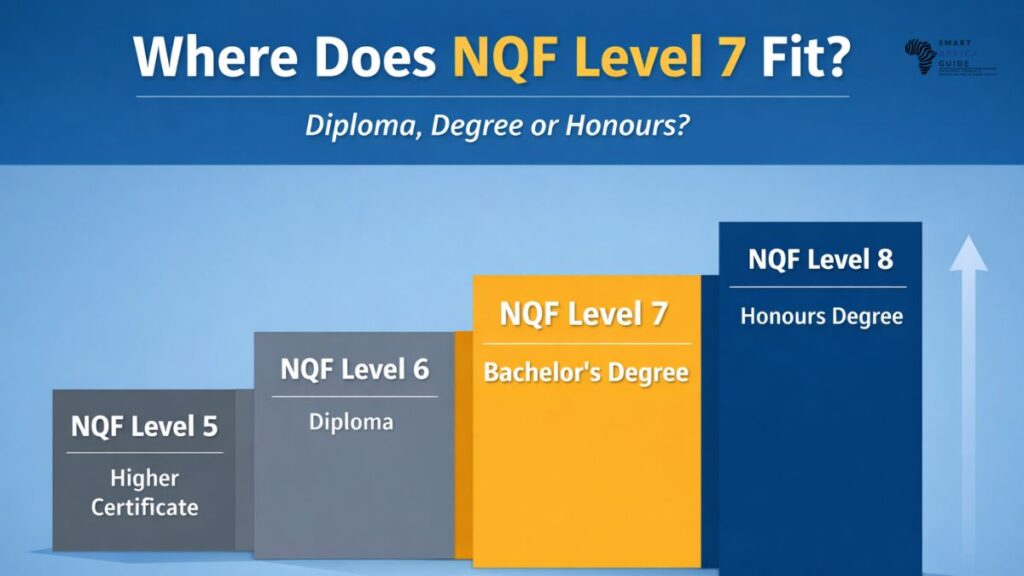
A simplified framework view helps illustrate this:
• NQF Level 5 → Higher Certificate
• NQF Level 6 → Diploma / Advanced Certificate
• NQF Level 7 → Bachelor’s Degree
• NQF Level 8 → Honours Degree / Postgraduate Diploma
This progression is critical when interpreting institutional criteria.
Diploma, Degree or Honours — Where Does Level 7 Fit?
One of the most common misunderstandings arises from mixing qualification types with NQF levels. Many students assume that diplomas and degrees may overlap at Level 7, but this is rarely the case.
Diplomas are typically classified at NQF Level 6, not Level 7. While diplomas are respected tertiary qualifications, they generally represent a lower academic complexity than bachelor’s degrees. Therefore, if an admission requirement specifies NQF Level 7, a diploma alone normally does not satisfy the condition unless the institution explicitly states otherwise.
Honours qualifications, on the other hand, belong to NQF Level 8. These programmes extend beyond bachelor’s study and involve greater theoretical depth, research orientation, and specialisation.
This distinction matters because incorrect comparisons can lead students to apply for programmes they are not yet eligible to enter.
Not sure whether your qualification leads to a degree, honours, or postgraduate route? Try the qualification path checker to see possible study pathways in South Africa.
Why Do Universities and Employers Use NQF Levels?

Qualification titles vary widely across institutions, which can create ambiguity. A bachelor’s degree may have different naming conventions depending on the university, yet the academic standard remains comparable. NQF levels eliminate this confusion by providing a uniform reference system.
By relying on levels instead of titles, institutions ensure consistent evaluation across:
• Admission decisions
• Job screening processes
• Professional registrations
• Academic progression routes
This approach also supports international recognition and comparison frameworks.
What Is NQF Level 5 Equivalent To?
Students often compare lower NQF levels when planning academic pathways. NQF Level 5 typically corresponds to a Higher Certificate qualification. These programmes are shorter, more introductory in nature, and academically less demanding than diplomas or degrees.
Higher certificates are valuable entry-level credentials and may provide foundational knowledge or access routes into further study. However, they are not equivalent to diploma or degree qualifications.
Understanding the distinction prevents unrealistic progression expectations.
Can You Progress From NQF Level 5 to NQF Level 7?
Progression is possible, though usually not immediate. A higher certificate does not normally grant direct entry into degree-level study. Instead, students typically follow a staged academic pathway.
A common progression route looks like this:
Higher Certificate (Level 5) → Diploma (Level 6) → Degree (Level 7)
Some universities may offer bridging arrangements or recognition of prior learning options, yet Level 5 alone rarely meets standard Level 7 admission criteria.
How Employers Interpret NQF Level 7
Employers generally view NQF Level 7 as a degree-level qualification benchmark. Job listings specifying this level usually expect candidates who have completed bachelor’s programmes. Diploma holders may be considered only if the employer explicitly accepts Level 6 qualifications.
For students entering the workforce, understanding this interpretation helps manage expectations and application strategies.
FAQ
What is an NQF Level 7 equivalent to?
In South Africa, NQF Level 7 most commonly equals a Bachelor’s Degree. It represents undergraduate degree-level study and sits above diploma qualifications (Level 6) but below honours qualifications (Level 8).
What is an NQF Level 6?
NQF Level 6 usually refers to a Diploma or Advanced Certificate. These qualifications are academically below bachelor’s degrees and focus more on applied or vocational learning.
Is Level 7 the same as a degree?
In South Africa, Level 7 usually indicates a Bachelor’s Degree standard. However, NQF levels describe academic complexity, not qualification names, so meanings vary across countries.
Is Level 7 a Bachelor’s Degree?
Yes, in South Africa NQF Level 7 most commonly represents a Bachelor’s Degree. Most undergraduate university degrees fall under this level.
Is NQF recognised internationally?
Yes, South Africa’s NQF supports international comparability, but equivalencies differ by country. Level numbers cannot always be directly matched without context.
Key Takeaway
NQF Level 7 most commonly represents the academic standard of a Bachelor’s Degree. It is not a diploma classification and does not indicate honours-level study. Recognising this prevents misinterpretation of admission requirements, career criteria, and qualification comparisons.
For students navigating South Africa’s education system, clarity around NQF levels removes a significant source of confusion and reduces the risk of costly academic misjudgements.

Varsha Asrani is a lecturer and education writer with experience as Visiting Faculty at AUPP and ATMC College, and as a Lecturer with TalentEdge and UpGrad. She is the Founder of the Asrani Institute of Education and Counselling. Varsha specializes in scholarships, e-learning, and career guidance for African students and professionals, and regularly visits Africa to gather first-hand insights that shape her research and articles.