
Last updated on September 29, 2026
Understanding the National Qualifications Framework (NQF) in South Africa is essential for anyone planning their education, career, or training pathway. The NQF maps all recognized qualifications, from basic schooling to the highest academic degrees, into a single structured system. This guide explains NQF levels for certificates and diplomas, focusing on NQF Levels 1–6, to help students understand post-school qualifications, vocational routes, and the right next step after school.
We also answer key student questions clearly, with up-to-date, verified information based on SAQA and recognized educational standards.
Important NQF Clarification
Qualifications registered at the same NQF level are not automatically equivalent. SAQA explains that each qualification has its own purpose and exit outcomes. For example, N4, N5 and N6 certificates are at NQF Level 5, but the completed National N Diploma—after the required workplace experience—is at NQF Level 6. Read our NATED vs NCV guide for the full distinction and check qualifications against the official SAQA guidance.
Quick Glance: NQF levels for certificates and diploma
- NQF Levels 1–3 cover foundational and intermediate certificates, roughly aligned with Grades 9 to 11, and focus on basic knowledge and skills.
- NQF Level 4 is the school-leaving level, which includes Matric (National Senior Certificate) and equivalent vocational certificates.
- NQF Level 5 includes Higher Certificates and post-school vocational qualifications, designed to prepare students for entry-level professional or technical roles.
- NQF Level 6 includes Diplomas and Advanced Certificates, offering deeper practical and theoretical training for skilled careers.
- Certificates focus on skills and entry into work, while diplomas provide broader competence and progression to degrees at higher NQF levels.
Table of Contents
What Is the National Qualifications Framework (NQF)?
The National Qualifications Framework (NQF) in South Africa is a 10-level system that categorizes all formal qualifications. It helps students, employers, and institutions understand the level of learning achieved in a qualification and how it relates to skills, complexity, and further learning opportunities.
The system also supports credit accumulation and transfer (CAT) and recognition of prior learning (RPL), although progression and credit recognition depend on the rules of the receiving institution.
Governed by the South African Qualifications Authority (SAQA), the NQF ensures qualifications meet national quality standards and are recognized across the education system.
How the NQF Levels Work
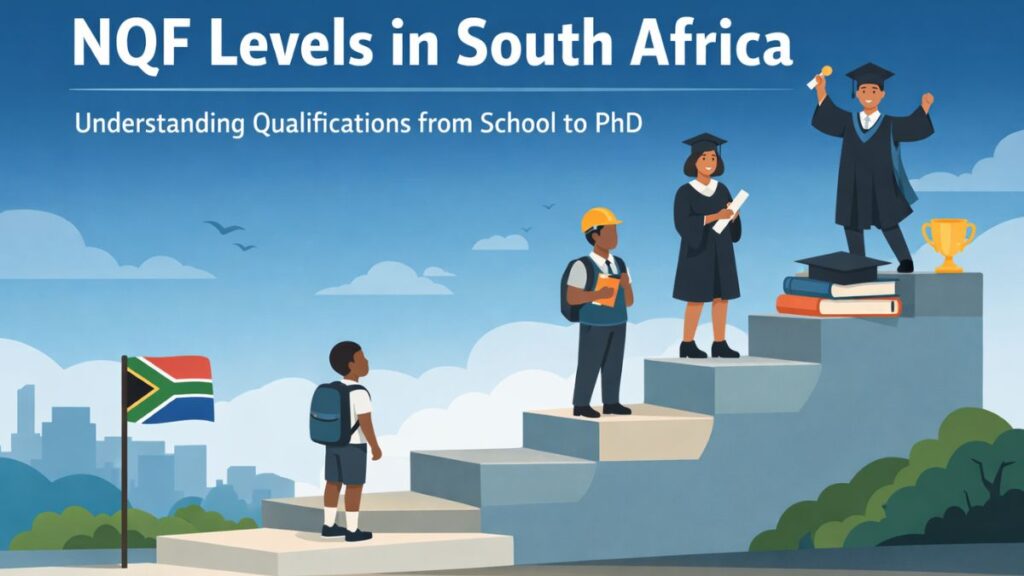
The NQF ranges from Level 1 (basic learning) to Level 10 (doctoral research). Each level describes the expected depth of knowledge, complexity of skills, and independence of learning. Levels 1–4 cover schooling and foundational learning, while levels 5–6 focus on post-school certificates and diplomas. This guide explains NQF levels for certificates and diplomas in South Africa, focusing on Levels 1 to 6 to help students choose the right post-school qualification.
Below, we explain the NQF levels for certificates and diplomas.
NQF Level 1 — Foundation Learning and Certificates
- Education level: This is the entry level for formal learning.
- Typical qualification: General Education and Training Certificate (equivalent to approx. Grade 9).
At NQF Level 1, learners begin building basic knowledge and skills, often in areas like literacy, numeracy, or short vocational courses. These qualifications can support entry into the workforce or progression to higher NQF levels.
Career pathway: Short-course certificates, entry-level jobs, basic work skills.
NQF Level 2 — Secondary Progression
- Education level: Equivalent to Grade 10.
- Typical qualification: National Certificates or specific vocational programmes.
At this interim level, learners deepen fundamental skills and start specialization in vocational fields. It prepares students for further schooling or basic vocational certificates.
Career pathway: Basic workplace roles; progression to Level 3 and beyond.
NQF Level 3 — Intermediate Learning
- Education level: Comparable to Grade 11.
- Typical qualification: National Certificates / vocational courses.
Level 3 builds on the foundation of Level 2. Learners gain broader knowledge and competencies and may start earning credits toward higher qualifications. At this level, many vocational and skills-based certificates begin to count toward formal diplomas or further training.
Career pathway: Help-desk roles, support positions, or entry into NQF Level 4 (matric or equivalent).
NQF Level 4 — Matric and Equivalent Certificates
- Education level: This is the end of general schooling — the National Senior Certificate (NSC) or equivalent vocational certificate.
- Typical qualification: Matric, NCV Level 4, vocational certificates.
Level 4 is the gateway to further post-school learning. With this qualification, learners can enter Higher Certificate or TVET (technical and vocational) programmes at Level 5, or begin work in entry-level roles.
Career pathway: Skilled operator, administrative assistant, basic technician roles.
NQF Level 4 includes the National Senior Certificate, commonly known as matric, which marks the completion of secondary education in South Africa; for a full breakdown, see matric and its NQF level.
NQF Level 5 — Higher Certificate and Initial Vocational Training
- Education level: Post-school (first level after matric).
- Typical qualification: Higher Certificates, N4-N6 Technical Certificates.
Level 5 qualifications focus on practical skills and foundational vocational knowledge. They are often offered by colleges, TVET institutions, and universities of technology. For example:
- Higher Certificate in Business, IT, or Engineering
- N4, N5, N6 (Technical/Trade certificates)
These certificates prepare learners for the workplace or further study. They often form the basis for progression to diplomas at Level 6 or even degrees at Level 7 with additional credits and RPL.
Career pathway: Junior technician, customer service practitioner, assistant roles.
At post-school level, NQF levels for certificates and diplomas show how learners progress from foundational skills at Level 5 to more specialised training at Level 6.
If you have a certificate or diploma and want to know what you can study next, use our qualification path tool for a simple guide.
NQF Level 6 — Diplomas and Advanced Certificates
- Education level: More advanced vocational or professional training.
- Typical qualification: National Diploma, Advanced Certificate.
Level 6 is a core qualification level for many careers. Diplomas and advanced certificates provide deeper learning in a field, combining theory with practical skills. These are usually completed in 2–3 years, depending on the institution and subject area.
Qualifications at this level can lead directly into employment or serve as pathways to bachelor’s degrees (Level 7), especially when paired with credits or bridging modules.
Career pathway: Technologist, junior management, specialized technical roles.
Understanding NQF levels for certificates and diplomas makes it easier to compare study options, entry requirements, and career outcomes across different institutions.

Comparison: Certificates vs. Diplomas
| NQF Level | Qualification Type | Learning Focus | Typical Outcome |
| Level 1 | Foundational Certificates | Basic literacy & numeracy | Entry into Level 2 |
| Level 2 | National Certificates | Intermediate skills | Progress to Level 3 |
| Level 3 | National Certificates / vocational programmes | Skill development | Preparation for Level 4 |
| Level 4 | Matric / Vocational Certificates | Secondary exit | Entry to Level 5 |
| Level 5 | Higher Certificates / Technical Certs | Practical post-school learning | Entry-level jobs |
| Level 6 | Diplomas / Advanced Certs | Career-oriented vocational training | Skilled roles, further study |
Key Benefits of NQF Certification
The NQF levels for certificates and diploma system provide a clear roadmap for education and careers. Its key strengths include:
- Structured progression: You can build from certificates to diplomas and degrees.
- National recognition: All registered qualifications are officially recognized across South Africa.
- Credit accumulation: Credits from one qualification can count toward another.
- RPL support: Work and life experience can help you gain credits for qualifications.
For students comparing study options after matric, NQF levels for certificates and diplomas provide a clear way to understand qualification value, duration, and progression opportunities.
Frequently Asked Questions
What Are the NQF Levels 1 to 10 in South Africa?
South Africa’s NQF has 10 levels that range from basic education to doctoral degrees:
Level 1: Grade 9 / basic certificates
Level 2: Grade 10 / national certificates
Level 3: Grade 11 / vocational certificates
Level 4: Matric / NCV 4
Level 5: Higher Certificates / TVET courses
Level 6: Diplomas / advanced certificates
Level 7: Bachelor’s degrees
Level 8: Honours and Postgraduate Diplomas
Level 9: Master’s degrees
Level 10: Doctoral degrees.
This structure helps learners and employers understand how qualifications relate, both academically and professionally.
What Is an NQF Level 7 Qualification in South Africa?
An NQF Level 7 qualification is typically a Bachelor’s degree or an Advanced Diploma. These qualifications involve deeper theoretical knowledge, research, and specialized skills. They prepare graduates for professional roles or further postgraduate study at Levels 8–10.
Is NQF Level 5 a Diploma in South Africa?
Not exactly. NQF Level 5 includes Higher Certificates and vocational certificates, not full diplomas. Diplomas are usually at Level 6. However, N4, N5 and N6 National N Certificates are at Level 5; together with the prescribed 18 or 24 months of workplace experience, they can lead to the National N Diploma at Level 6.
Which Certificate Is in Demand in South Africa?
While demand varies by industry, Level 5 Higher Certificates and Level 6 Diplomas in fields like IT, Business, Engineering, Accounting, and Health Sciences remain highly sought after due to their direct link to employment and vocational skills training. Specific demand can shift with economic trends, so learners should also consult labor market data when choosing their field.
This article focuses on certificates and diplomas at NQF Levels 1–6, but students who want a broader context can read our guide on how NQF levels work in South Africa, which covers the full framework from Level 1 to Level 10.
Final Words on NQF Levels for Certificates and Diplomas
In South Africa, NQF Levels 1–6 (NQF levels for certificates and diplomas) cover the essential journey from foundation learning to advanced vocational proficiency. By understanding NQF levels for certificates and diplomas, students can plan a clear education pathway that supports employment, further study, and long-term career growth.
- Levels 1–3 build basic skills and prepare learners for success in education and early careers.
- Level 4 is the matric/secondary school exit that unlocks post-school study.
- Level 5 equips students with practical, workplace-ready skills through Higher Certificates and technical training.
- Level 6 builds deeper competence with diplomas and advanced certificates, offering both job opportunities and study progression.
Thanks to the NQF’s integrated structure, learners can clearly see where they are now and where they can go next — whether that’s gaining skills for employment or advancing toward a degree. Use this framework to plan smart study choices, match qualifications to career goals, and make the most of your learning achievements.

Varsha Asrani is a lecturer and education writer with experience as Visiting Faculty at AUPP and ATMC College, and as a Lecturer with TalentEdge and UpGrad. She is the Founder of the Asrani Institute of Education and Counselling. Varsha specializes in scholarships, e-learning, and career guidance for African students and professionals, and regularly visits Africa to gather first-hand insights that shape her research and articles.