

Last updated on July 6, 2026
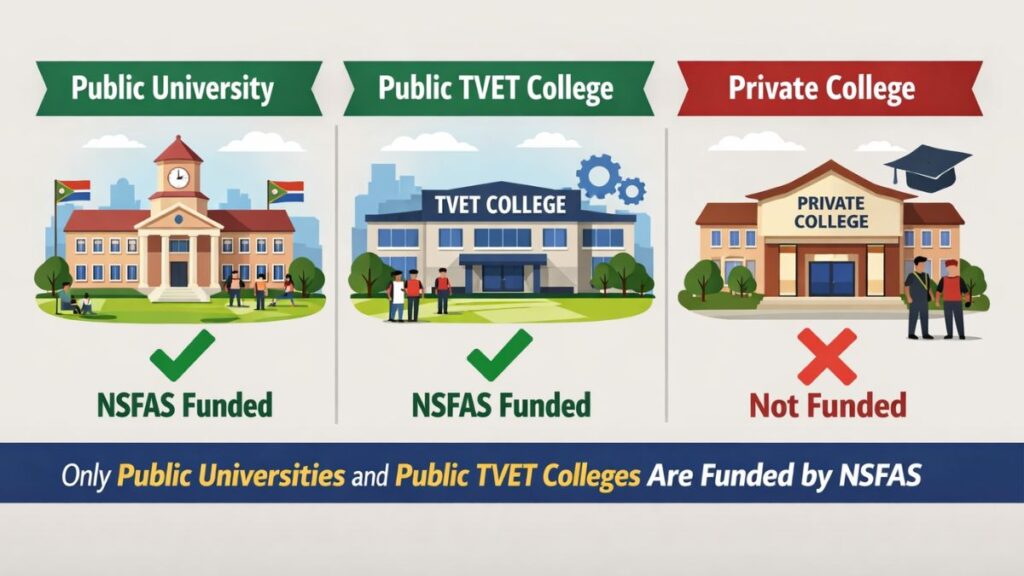
If you’re trying to figure out whether your college is funded by NSFAS, here’s the one thing that actually decides it: is the institution public or private? NSFAS funds all 26 public universities and all 50 public TVET colleges in South Africa. It does not fund private colleges, private campuses, or private training institutes, no matter what a recruiter or a flyer tells you.
A lot of students only find this out after they have already signed up and paid a deposit. Below is the full list, organised by province, plus how to double-check any institution yourself before you register.
Quick Glance
- Funded: All public universities (26)
- Funded: All public TVET colleges (50)
- Not funded: Private colleges, private campuses, and private training institutes
- How to confirm: If the institution is public and appears on the official NSFAS institutions list, it qualifies
- What matters most: Your institution + programme eligibility + financial eligibility + academic rules (N+)
Table of Contents
Which Colleges Does NSFAS Fund?

NSFAS-Funded TVET Colleges
NSFAS funding applies to public TVET colleges (not private).
Eastern Cape
- Buffalo City TVET College
- Eastcape Midlands TVET College
- Ikhala TVET College
- Ingwe TVET College
- King Hintsa TVET College
- King Sabatha Dalindyebo TVET College
- Lovedale TVET College
- Port Elizabeth TVET College
Free State
- Flavius Mareka TVET College
- Goldfields TVET College
- Maluti TVET College
- Motheo TVET College
Gauteng
- Central Johannesburg TVET College
- Ekurhuleni East TVET College
- Ekurhuleni West TVET College
- Sedibeng TVET College
- South West Gauteng TVET College
- Tshwane North TVET College
- Tshwane South TVET College
- Western TVET College
KwaZulu-Natal
- Coastal KZN TVET College
- Elangeni TVET College
- Esayidi TVET College
- Majuba TVET College
- Mnambithi TVET College
- Mthashana TVET College
- Thekwini TVET College
- Umfolozi TVET College
- Umgungundlovu TVET College
Limpopo
- Capricorn TVET College
- Lephalale TVET College
- Letaba TVET College
- Mopani South East TVET College
- Sekhukhune TVET College
- Vhembe TVET College
- Waterberg TVET College
Mpumalanga
- Ehlanzeni TVET College
- Gert Sibande TVET College
- Nkangala TVET College
Northern Cape
- Northern Cape Rural TVET College
- Northern Cape Urban TVET College
North West
- Orbit TVET College
- Taletso TVET College
- Vuselela TVET College
Western Cape
- Boland TVET College
- College of Cape Town
- False Bay TVET College
- Northlink TVET College
- South Cape TVET College
- West Coast TVET College
Verified source basis: NSFAS states it funds at 50 TVET colleges and provides an official institution directory.
NSFAS-Funded Universities

NSFAS provides funding at 26 public universities.
Public universities funded by NSFAS
- Cape Peninsula University of Technology (CPUT)
- Central University of Technology (CUT)
- Durban University of Technology (DUT)
- Mangosuthu University of Technology (MUT)
- Nelson Mandela University (NMU)
- North-West University (NWU)
- Rhodes University
- Sefako Makgatho Health Sciences University (SMU)
- Sol Plaatje University (SPU)
- Stellenbosch University
- Tshwane University of Technology (TUT)
- University of Cape Town (UCT)
- University of Fort Hare (UFH)
- University of Johannesburg (UJ)
- University of KwaZulu-Natal (UKZN)
- University of Limpopo (UL)
- University of Mpumalanga (UMP)
- University of Pretoria (UP)
- University of South Africa (UNISA)
- University of Stellenbosch (SU)
- University of the Free State (UFS)
- University of the Western Cape (UWC)
- University of the Witwatersrand (Wits)
- University of Venda (UNIVEN)
- University of Zululand (UniZulu)
- Vaal University of Technology (VUT)
How to Confirm If a College Is Funded by NSFAS

Do not trust flyers, WhatsApp posters, or “agent” promises. Use this check:
Step 1: Confirm the institution is public
If it is a public TVET or public university, NSFAS funding is possible.
Step 2: Verify on NSFAS’ official “Institutions” directory
NSFAS maintains a public directory showing the institutions where it provides funding.
If the institution is not on that NSFAS list, do not assume NSFAS will pay.
FAQs
Can NSFAS fund me if I change from one university/college to another?
Yes, but NSFAS funds one institution at a time. If both institutions show you as active, funding can be delayed until records are corrected.
My college says “accredited.” Does that mean NSFAS will pay?
No. “Accredited” does not mean “public.” NSFAS funding depends on whether the institution is public and recognized for NSFAS funding.
Does NSFAS fund private colleges?
No. NSFAS funding is for students studying at public universities and public TVET colleges. If a private college tells you “NSFAS will pay,” ask them to show proof on the official NSFAS institution directory. If they cannot, treat it as a red flag.
Which colleges qualify for NSFAS?
NSFAS funds students who study at public TVET colleges and public universities in South Africa. Private colleges do not qualify for NSFAS funding.
Which TVET college can I study online?
Most public TVET colleges are primarily campus-based, but some offer limited online or blended learning options depending on the programme and campus. The correct way is to choose your preferred public TVET college first, then confirm on its official site or with the campus whether your programme supports online delivery.
How many years does NSFAS fund you?
NSFAS funds you within the N+ rule limits. In simple terms, NSFAS funds up to the minimum duration of your qualification , plus a limited extra time, but funding can stop if you exceed the allowed years.
Final Checklist
Before you register anywhere, always confirm the following:
- The institution is public (TVET college or university)
- It appears on the official NSFAS institution directory
- Your programme is eligible for NSFAS funding (especially important for TVET students)
If any one of these is missing, NSFAS will not fund your studies, even if the college claims it is funded by NSFAS.
Note: This guide is based on official NSFAS and DHET funding rules for public institutions.

Varsha Asrani is a lecturer and education writer with experience as Visiting Faculty at AUPP and ATMC College, and as a Lecturer with TalentEdge and UpGrad. She is the Founder of the Asrani Institute of Education and Counselling. Varsha specializes in scholarships, e-learning, and career guidance for African students and professionals, and regularly visits Africa to gather first-hand insights that shape her research and articles.

