

Last updated on March 13, 2026
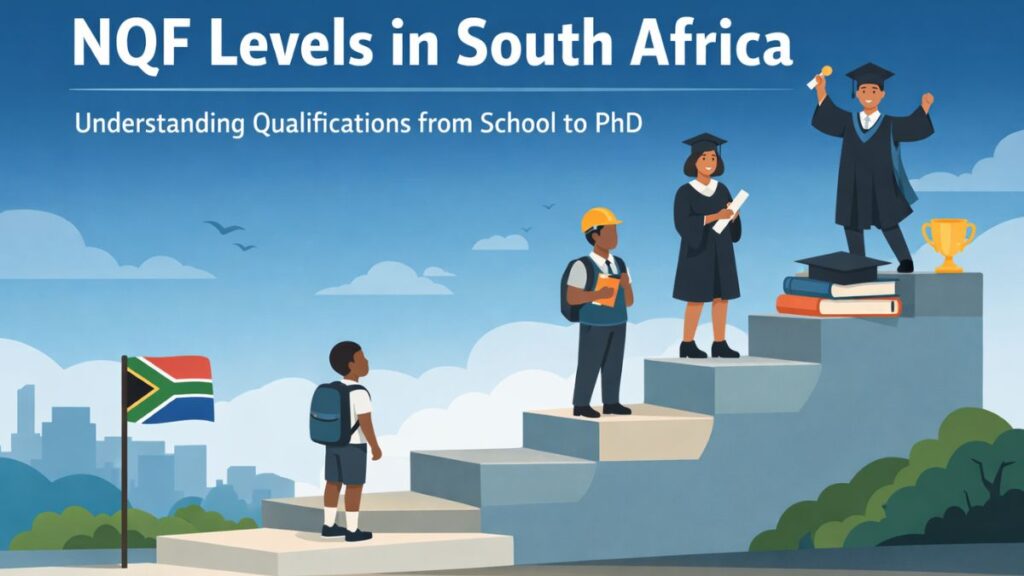
The NQF levels system is the official way South Africa classifies education and training qualifications, from school level through to doctoral degrees. If you have ever seen an NQF number on a course prospectus, job advert, or application form and felt confused, you are not alone. Many students encounter these levels without ever being properly told what they mean or why they matter.
This write-up explains NQF levels in South Africa in simple terms. It covers the NQF meaning, how the system works, what each NQF level represents, and how these levels affect your study, funding, and career options.
Quick Glance
- The NQF has 10 levels, from basic schooling to doctoral degrees
- Matric (Grade 12) is classified as NQF Level 4
- Certificates and diplomas fall between NQF Levels 5 and 6
- Bachelor’s degrees are placed at NQF Level 7
- Honours and postgraduate diplomas are NQF Level 8
- Master’s and PhD degrees fall under NQF Levels 9 and 10
Table of Contents
What Is NQF?
The National Qualifications Framework, commonly referred to as the NQF, is South Africa’s official system for organizing and recognizing education and training achievements. It applies to schools, TVET colleges, universities, and occupational training programmes across the country.
“The National Qualifications Framework provides a single, integrated system for classifying learning achievements in South Africa.”
In short, the NQF ensures that qualifications are:
- Standardized
- Recognized nationally
- Comparable across institutions
- Aligned to clear learning outcomes
What does NQF stand for?
NQF stands for National Qualifications Framework. The framework is overseen by the South African Qualifications Authority, often referred to as SAQA. SAQA is responsible for registering qualifications and ensuring that they meet national quality standards.
What Is an NQF Level and Why It Matters
An NQF level is a number that shows the complexity and depth of a qualification. The higher the level, the more advanced the learning, skills, and knowledge required.
When students ask what is NQF level, they are really asking how qualifications are ranked and what those rankings mean for progression.
What does NQF level mean in practical terms?
If you are wondering what does NQF level mean, it tells you:
- How advanced a qualification is
- What you are eligible to study next
- Whether a qualification meets entry requirements for funding or employment
- How your qualification compares to others in South Africa
Understanding NQF levels is especially important when applying for further study, funding support, or jobs that specify minimum qualification requirements.
NQF Levels in South Africa

There are 10 official NQF levels in South Africa, covering the full education pathway from basic schooling to doctoral research. These NQF levels in South Africa create a structured progression system that supports lifelong learning.
Below is a simplified overview of all NQF levels in South Africa.
NQF Levels Table (South Africa)
| NQF Level | Qualification Type | Common Examples | What You Can Do Next |
| Level 1 | General Education | Grade 9 | Continue schooling |
| Level 2 | School / Vocational | Grade 10 | Progress to Level 3 |
| Level 3 | School / Vocational | Grade 11 | Progress to Level 4 |
| Level 4 | School Completion | Matric (NSC) | Higher Certificate, TVET, some Diplomas |
| Level 5 | Higher Certificate | Higher Certificate | Progress to Diploma or Degree |
| Level 6 | Diploma / Advanced Certificate | National Diploma | Progress to Degree |
| Level 7 | Degree / Advanced Diploma | Bachelor’s Degree | Honours or Postgraduate Diploma |
| Level 8 | Honours / Postgraduate Diploma | Honours Degree | Master’s Degree |
| Level 9 | Master’s Degree | MA, MSc, MBA | Doctoral studies |
| Level 10 | Doctoral Degree | PhD | Research and academic careers |
Each level builds on the previous one, allowing students to move step by step through the education system.
In addition to academic qualifications, many skills-based programmes registered on the NQF are offered through SETAs. These programmes focus on practical training and are commonly available in sectors such as transport, construction, manufacturing, and logistics.
What NQF Level Is Matric in South Africa?
One of the most common questions students ask is where Matric fits into the system.
In South Africa, Matric, officially known as the National Senior Certificate, is classified as NQF Level 4.
This means that completing Matric places you at Level 4 on the NQF and allows you to apply for:
- Higher Certificate programmes at NQF Level 5
- TVET college qualifications
- Certain diploma and degree programmes, depending on your marks and subject choices
Understanding this placement helps students plan realistic study pathways after school.
NQF Levels for Certificates and Diplomas
Certificates and diplomas play a major role in South Africa’s education system, particularly for students who want practical, career-focused qualifications.
- NQF Levels 1–3 generally cover basic schooling and entry-level vocational learning.
- NQF Level 4 marks the completion of school education.
- NQF Level 5 includes Higher Certificates and advanced vocational training.
- NQF Level 6 typically includes National Diplomas and Advanced Certificates.
Diplomas at Level 6 are not degrees, but they are respected qualifications that can open pathways to employment or further study at degree level.
Many transport-related vocational and occupational qualifications in South Africa are linked to the Transport Education and Training Authority (TETA), which supports accredited learnerships and skills programmes registered on specific NQF levels.
Which NQF Level Is a Degree in South Africa?
Degrees are placed higher on the framework because they require more advanced academic learning.
In South Africa:
- Bachelor’s degrees are usually classified at NQF Level 7
- Honours degrees and postgraduate diplomas fall under NQF Level 8
This distinction is important for students planning postgraduate study or applying for professional roles that require degree-level qualifications.
What Is NQF Level 7 and Why Is It Often Confusing?
NQF Level 7 causes confusion because it can include both:
- Bachelor’s degrees
- Advanced Diplomas
This leads many students to ask whether Level 7 is a diploma or a degree. The answer depends on the qualification type, not just the level number. Both can exist at the same level but serve different academic and career purposes.
What NQF Level Is a Master’s and a PhD?
Postgraduate qualifications sit at the highest end of the framework.
- NQF Level 9 is reserved for Master’s degrees
- NQF Level 10 represents Doctoral degrees, including PhDs
These levels involve advanced research, independent study, and original contributions to knowledge.
Are NQF Levels Recognized Internationally?

Although the NQF is specific to South Africa, it is aligned with international qualification frameworks. This means South African qualifications are often recognized abroad, although formal evaluation may be required when studying or working overseas.
Graduates are usually advised to verify recognition requirements with the relevant international bodies or institutions.
Common Questions About NQF Levels
Many students still wonder how the system applies to their personal situation. Common concerns include:
- Whether a particular NQF level qualifies them for university
- How to move from a diploma to a degree
- Which qualifications are recognized by employers
The NQF was designed to create flexibility and progression, making it possible for learners to move forward at different stages of life.
FAQs
What are the NQF levels?
The NQF levels are a 10-level framework used in South Africa to classify qualifications based on their complexity and learning outcomes. The levels start from NQF Level 1, which covers basic education, and go up to NQF Level 10, which represents doctoral degrees. These levels help learners, institutions, and employers understand how qualifications compare and progress.
What is NQF 7 equivalent to?
In South Africa, NQF Level 7 is equivalent to a Bachelor’s degree or an Advanced Diploma. Both qualifications sit at the same level on the framework, but they differ in focus. A Bachelor’s degree is more academic, while an Advanced Diploma is usually more professionally or career-oriented.
Is NQF level 8 a degree?
Yes. NQF Level 8 includes Honours degrees and Postgraduate Diplomas in South Africa. These qualifications are completed after a Bachelor’s degree and are commonly required for admission into a Master’s degree programme.
Is level 7 a diploma?
No. NQF Level 7 is not a diploma. Diplomas are generally classified at NQF Level 6. Level 7 qualifications are higher and include Bachelor’s degrees and Advanced Diplomas.
Which NQF level is BA?
A Bachelor of Arts (BA) degree in South Africa is classified at NQF Level 7. This applies to most undergraduate Bachelor’s degree programmes offered by recognized universities.
What NQF is a BCom?
A Bachelor of Commerce (BCom) degree is also classified at NQF Level 7 in South Africa. Like other Bachelor’s degrees, it provides a pathway to Honours and postgraduate study.
What level is a PhD?
A PhD (Doctoral Degree) is classified at NQF Level 10, which is the highest level on the National Qualifications Framework in South Africa. It represents advanced research and original contributions to knowledge.
Final Summary
The NQF levels system provides a clear structure for education and training in South Africa. By understanding the NQF meaning, knowing what is NQF, and recognizing what does NQF level mean, students can make better decisions about their education paths.
Whether you are finishing school, considering a diploma, or planning postgraduate study, understanding NQF levels in South Africa helps you choose qualifications that align with your goals and opens doors to further opportunities.

Varsha Asrani is a lecturer and education writer with experience as Visiting Faculty at AUPP and ATMC College, and as a Lecturer with TalentEdge and UpGrad. She is the Founder of the Asrani Institute of Education and Counselling. Varsha specializes in scholarships, e-learning, and career guidance for African students and professionals, and regularly visits Africa to gather first-hand insights that shape her research and articles.

