


Last updated on March 17, 2026
Writing a motivational letter for a bursary can feel confusing, especially when you are not sure what selection panels actually want to read. The truth is simple. In recent years, several bursary providers and university financial-aid offices have confirmed that they do not prioritise fancy language or long scholarship essays. They want to understand your goals, your situation, and why the bursary matters to you.
A strong motivational letter explains three things clearly: what you want to study, why you need financial support, and how the bursary will help you move forward. When these points are written honestly and directly, your application becomes much easier to understand and much harder to ignore. This guide shows you exactly how to write a motivational letter step by step, with a simple structure, real examples, and a sample you can adapt for your own application.
Quick Glance: Motivational Letter for a Bursary (2027)
- Focus on three things: your goals, your financial need, and your future plans
- Use simple, natural language instead of complex or formal writing
- Follow a clear structure that selection panels can easily understand
- Add real examples from your studies or personal experience
- Avoid common mistakes like copying templates or writing too much
Table of Contents
Why a Motivational Letter for a Bursary Matters More
Several bursaries in South Africa, including well-known government and private institutions, recently shared that they are receiving more applications than ever before. When the competition grows, they rely heavily on the motivational letter to understand two things:
- Does the applicant have a clear academic or career goal?
- Will the bursary make a real difference in their studies?
Students who mention specific goals, subjects they enjoy, and the challenges they are trying to overcome usually leave a strong impression.
What Experts Say Every Motivational Letter Should Include
Education funding consultants often repeat the same advice: keep your letter simple, direct, and personal. Below is a structure that works well for almost every bursary or scholarship in Africa.
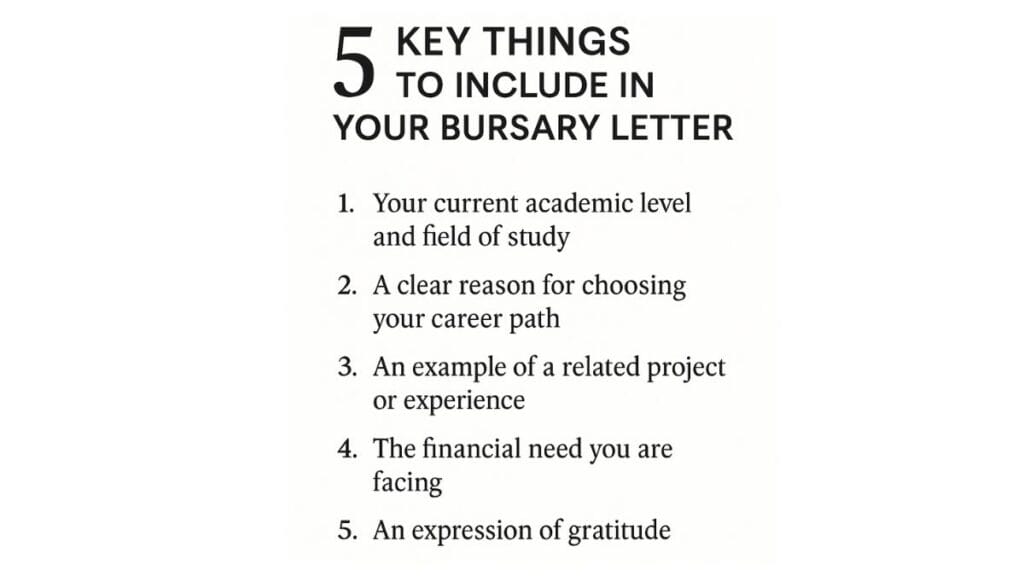
1. Start With a Short Introduction
Mention your name, your current level of study, and the bursary you are applying for. Panels appreciate applicants who get straight to the point.
2. Explain Your Academic Interests
Share what you are studying or planning to study, and describe what makes the field meaningful to you. Real examples help—such as a subject you enjoyed, a project you completed, or a challenge you overcame in school.
3. Describe Your Career Goal
A clear goal shows maturity. Even if the goal may change later, demonstrating direction builds confidence in your application.
4. Be Honest About Financial Need
Funding organisations want to help students who need support. A short explanation of your situation is more than enough. So make sure when you write the motivational letter for a bursary, you remain honest about your financial need.
5. Show How the Bursary Will Help You
Explain how the funding will make a difference—allowing you to buy textbooks, stay in residence, focus on your studies, or reduce financial pressure at home.
6. End With Confidence and Gratitude
A simple closing line thanking the panel for considering your application leaves a warm impression.
Sample Template of Motivational Letter for a Bursary
Panels prefer real stories, but if you need a starting point, this structure works well:
Dear Selection Committee,
My name is [Your Name], and I am applying for the [Name of Bursary] for the 2026 academic year. I am currently in [Grade or University Level] and plan to continue my studies in [Field or Course].
I have always enjoyed [subject or activity], and over time it inspired me to pursue a career in [career goal]. This field means a lot to me because [short personal reason].
My family has supported me as much as possible, but financial challenges make it difficult for me to continue studying without assistance. Receiving this bursary will help me focus on my work, buy the materials I need, and complete my degree without constant pressure.
Thank you for taking the time to consider my application. I am committed to working hard and contributing positively to my community through my education.
Sincerely,
[Your Name]
Common Mistakes Students Should Avoid
Education advisors often mention a few mistakes that make letters weaker. Avoiding them can quickly improve your chances.
- Writing long introductions before mentioning the bursary
- Using complicated words instead of natural language
- Copying templates without adding personal details
- Including unrelated stories that distract from the main point
- Forgetting to mention financial need
- Not stating a clear academic or career goal
A natural tone is always better than a formal one that sounds forced.
How to Improve Your Chances of Getting the Bursary
Applicants who stand out usually do these simple things:
- Read the bursary requirements carefully before writing
- Keep the letter between one and one-and-a-half pages
- Mention subjects or projects that genuinely matter to them
- Ask a teacher or mentor to read the letter once before sending
- Submit all required documents together with the letter
These small steps show commitment and responsibility, qualities bursary committees value highly.
FAQs
How do I write a motivational letter for Funza Lushaka?
For the Funza Lushaka bursary, you should focus on your passion for teaching, the subjects you want to teach, and your commitment to working in public schools after graduation.
Why should I be considered for a bursary?
Explain your goals, your financial need, and how the funding will help you succeed academically.
What should I say about myself in a motivational letter for a bursary?
Share qualities that reflect your character—dedication, curiosity, teamwork, or community involvement.
Conclusion
A motivational letter for a bursary does not need to be perfect, but it needs to be clear, honest, and focused. Selection panels read many applications, and the ones that stand out are usually the ones that explain goals and challenges in a simple and direct way.
Taking time to organise your thoughts, follow a clear structure, and write in your own words can make a big difference. Even small improvements, such as adding real examples or explaining your financial situation properly, can strengthen your application.
Before submitting, read your letter once more and check if it answers one simple question: why should this bursary support you? If your answer is clear, your letter is ready.

Varsha Asrani is a lecturer and education writer with experience as Visiting Faculty at AUPP and ATMC College, and as a Lecturer with TalentEdge and UpGrad. She is the Founder of the Asrani Institute of Education and Counselling. Varsha specializes in scholarships, e-learning, and career guidance for African students and professionals, and regularly visits Africa to gather first-hand insights that shape her research and articles.

