


Last updated on January 8, 2026
Education funding in Africa is often framed as a matter of access, equity, or social responsibility. While those dimensions are real, they miss a more important point. Education funding is also one of the clearest early signals of how future capability is being built across the continent.
For business leaders thinking in long-term horizons, this matters. Talent does not suddenly appear at the point of recruitment. It is shaped years earlier through exposure, training, and opportunity. Scholarships and education funding programs operate at that formative stage, long before companies begin competing for skills.
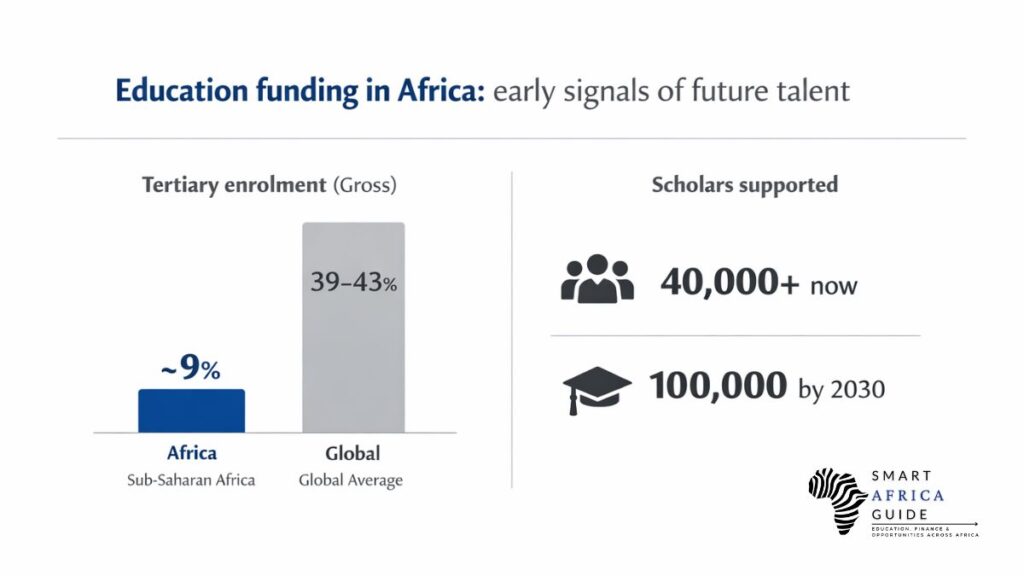
Table of Contents
The Scale of the Education Gap
The numbers alone explain why education funding carries strategic weight.
According to UNESCO and the World Bank, Sub-Saharan Africa’s gross tertiary enrolment ratio is around 9 percent, compared to a global average of over 40 percent. This gap is not just about access to universities. It reflects a structural constraint on how quickly high-level skills can be developed and scaled.
At the same time, Africa has the youngest population in the world. The International Labour Organization projects that youth unemployment in Sub-Saharan Africa will remain close to 9 percent through the mid-2020s, with underemployment far higher. This combination of a young population and limited access to higher education creates a bottleneck. Education funding is one of the few levers capable of easing it.
From a strategic perspective, funding decisions in education highlight where that bottleneck is being deliberately addressed.
Why Scholarships Matter More Than They Appear
Scholarships in Africa are often discussed as isolated opportunities for individual students. In reality, they function more like targeted capability investments.
Large-scale programs do not fund tuition alone. They concentrate resources around specific disciplines, institutions, and geographies. Over time, these choices shape the composition of the future workforce.
For example, the Mastercard Foundation Scholars Program has committed billions of dollars toward higher education and transition-to-work initiatives across Africa. The program supports tens of thousands of scholars, with an explicit focus on leadership development, employability, and community impact. That scale is not accidental. It reflects an understanding that education is a long-term investment in systems, not a short-term intervention.
Other global and regional foundations follow similar patterns, prioritising areas such as STEM, public policy, health, climate resilience, and entrepreneurship. These priorities act as indicators of where future demand for advanced skills is expected to grow.
Education Funding as Market Intelligence
For companies, education funding in Africa offers a form of early market intelligence that is often overlooked.
When multiple funding bodies concentrate resources in a particular field or region, it signals anticipated skill demand five to ten years ahead. Universities adapt curricula. Students cluster into funded disciplines. Networks and alumni ecosystems form. By the time these graduates enter the labour market, competition for their skills is already intense.
Organisations that pay attention earlier gain an advantage. They understand not only which skills will be scarce, but also where those skills are being nurtured and under what conditions. This insight supports better hiring strategies, partnership decisions, and long-term workforce planning.
Ignoring these signals leaves companies reacting late, often at higher cost.
Beyond Hiring: Why Leadership Formation Starts Early
Another reason education funding deserves attention is its role in shaping leadership quality.
Many scholarship programs emphasise mentorship, civic engagement, and ethical leadership alongside academic performance. The intention is not simply to produce degree holders, but individuals capable of navigating complex systems and responsibility.
From a business standpoint, this matters. Leadership deficits often limit scalability more than capital constraints. Markets expand faster than managerial depth. Education funding that integrates leadership development directly influences the calibre of future executives, founders, and senior professionals.
This helps explain why education funding is increasingly aligned with long-term development goals rather than narrow academic outcomes.
Capability, Not Capital, Drives Sustainable Growth
Africa has not lacked capital flows in recent decades. What has often lagged is the consistent development of high-level capability across sectors.
Education funding addresses this imbalance directly. It builds human capital at a pace that markets alone cannot achieve. Over time, this capability determines execution quality, institutional strength, and innovation capacity.
For CEOs and senior leaders, the implication is straightforward. Tracking education funding in Africa is not about philanthropy. It is about understanding where future growth will be constrained or enabled by talent.
Those who see education funding as a strategic signal position themselves earlier in the cycle of opportunity. Those who dismiss it as a social issue often arrive late, competing for scarce skills after the groundwork has already been laid.
At Smart Africa Guide, we view education funding not as a collection of opportunities, but as a map of how Africa’s future workforce is being built. For decision-makers thinking beyond quarterly results, it is a signal worth paying attention to.

Varsha Asrani is a lecturer and education writer with experience as Visiting Faculty at AUPP and ATMC College, and as a Lecturer with TalentEdge and UpGrad. She is the Founder of the Asrani Institute of Education and Counselling. Varsha specializes in scholarships, e-learning, and career guidance for African students and professionals, and regularly visits Africa to gather first-hand insights that shape her research and articles.

