
Last updated on May 28, 2026
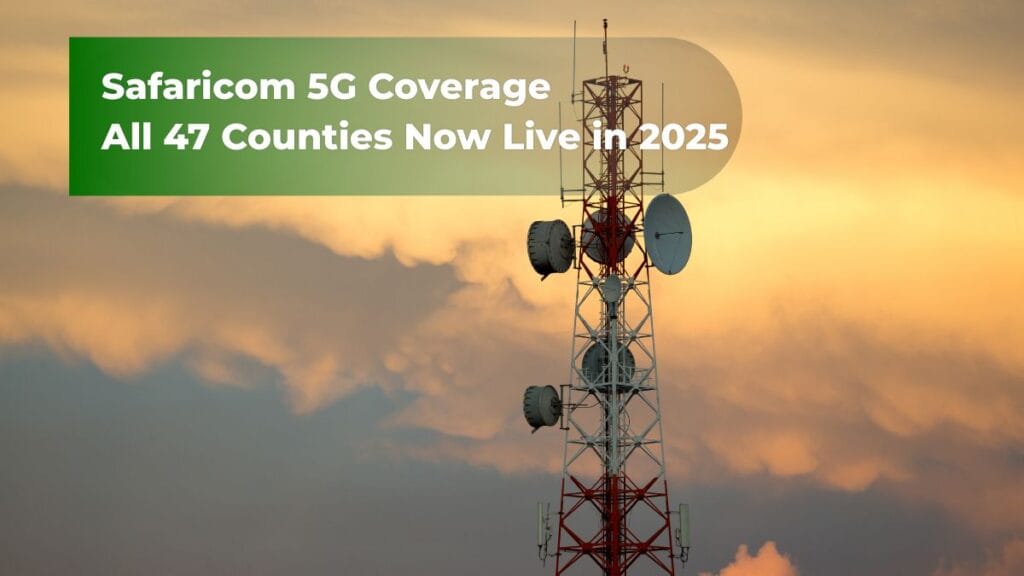
When Safaricom confirmed that its 5G network is now active in all 47 counties, the announcement immediately drew attention. Coverage has expanded quickly over the last year, reaching more towns and trading centres that had previously relied only on 4G.
Even with this wider footprint, the overall Safaricom 5G population reach remains low, and that contrast is shaping discussions around network growth heading into 2025.
Safaricom’s latest update shows that the company now has 311 5G locations across Kenya. These include high-traffic areas such as Nairobi, Mombasa, Kisumu, Eldoret, Nakuru, and parts of emerging towns. The network has crossed 1,114 active 5G sites, and the number of 5G-capable smartphones on the network has grown to over 780,000.
For readers who also follow mobile money updates, our M-Pesa to Airtel Money guide explains how cross-network transfers are changing alongside new network upgrades.
Despite this progress, only about 14% of Kenyans currently have access to usable 5G coverage. Many of the newly activated counties have spot coverage, mostly around business districts, universities, industrial zones and selected residential clusters.
What Has Changed in Safaricom 5G Rollout
The company’s 5G expansion has been much faster over the past year. Part of the push is driven by increased demand for home and business internet, as well as competition from Airtel’s growing 5G network.
Safaricom’s strategy has focused on:
- Expanding to underserved counties
- Adding new 5G sites to existing 4G towers
- Supporting more 5G-compatible devices
- Improving backhaul capacity for faster speeds
- Preparing for broader 5G Home usage
These moves align with the company’s wider network investment programme, which has also included upgrades in Ethiopia.
As Safaricom expands its network capacity, mobile payments continue to grow across Kenya. You can see this shift clearly in everyday services, such as how to pay NHIF via M-Pesa, which rely heavily on stable network performance.
5G Speeds and Real-World Usage
Safaricom’s 5G speeds vary based on location and device compatibility. In strong-signal zones, users report significantly higher upload and download speeds compared to 4G, especially for:
- Video streaming
- Online learning
- Remote work
- Cloud applications
- High-bandwidth business operations
However, outside urban or semi-urban clusters, speeds may not show a dramatic improvement yet. This is expected to change as more dedicated 5G sites are added through 2025.
Anyone using Airtel can also check this step-by-step guide to link NIN to Airtel officially, which helps avoid service interruptions.
Why Overall Safaricom 5G Adoption Is Still Low
Even though coverage has reached all 47 counties, several factors limit real-world adoption:
- 5G-enabled phones remain expensive
- Wide-area coverage is still growing
- Many people rely on 4G bundles and routers
- Awareness of 5G benefits is low outside major towns
- 4G remains stable enough for everyday use
For most users, the switch to 5G is happening gradually as devices become more affordable and coverage improves.
What to Expect in 2025
Safaricom 5G rollout is expected to continue at a steady pace throughout 2025. The focus areas include:
- Expanding population-level coverage
- More 5G Home packages
- Device financing for 5G phones
- Improved rural 5G penetration
- More dedicated 5G sites in high-demand markets
Competition with Airtel, which has also expanded its 5G presence, may accelerate network investment and improve overall speeds for consumers.
Key Takeaways
- Safaricom’s 5G rollout is county-wide but not fully population-wide.
- Urban and semi-urban areas enjoy the most reliable coverage.
- 5G speeds show clear improvement but vary by location and device.
- Adoption remains low mainly due to device cost and limited awareness.
- 2025 will bring more dedicated sites, better speeds and broader usage.

Tarun Asrani is the founder and editor-in-chief of SmartAfricaGuide. With extensive experience in digital publishing and content strategy, he leads the platform’s focus on finance, scholarships, e-learning, and career opportunities shaping Africa today. Tarun visits Africa twice a year, gaining first-hand exposure to local education systems, job markets, and emerging technologies. He also closely follows African news, university updates, and government initiatives to ensure SmartAfricaGuide delivers timely, accurate, and practical insights grounded in real regional experience.